

Stage 1: What is “the Honest Unknown Principle”?
I would define the concept provisionally as:
An honest unknown is a question for which the available evidence does not justify collapsing uncertainty into a conclusion.
The key word is not unknown. It is honest.
We can fail epistemically in two directions:
False certainty:
“I know X.”…when our evidence only supports: “X seems plausible.”
But we can also fail in the opposite direction:
False uncertainty:
“We just can’t know.”…when sufficient evidence actually exists to make a useful judgment.
So the principle isn’t really:
Admit what you don’t know.
That’s too easy. It is closer to:
Represent the state of your knowledge at the resolution the evidence actually permits.
That distinction matters enormously.
Sometimes the honest answer is: Known.
Sometimes: Probably.
Sometimes: Plausible, but weak evidence.
Sometimes: We don’t currently know.
And occasionally: We cannot know from the information available.
Those are very different epistemic states.
Where the idea comes from
There isn’t one bloodline. There are several tributaries feeding the same river.
One of the oldest is Socratic ignorance. Socrates’ intellectual advantage is traditionally framed not as knowing everything, but recognizing where his knowledge ends.
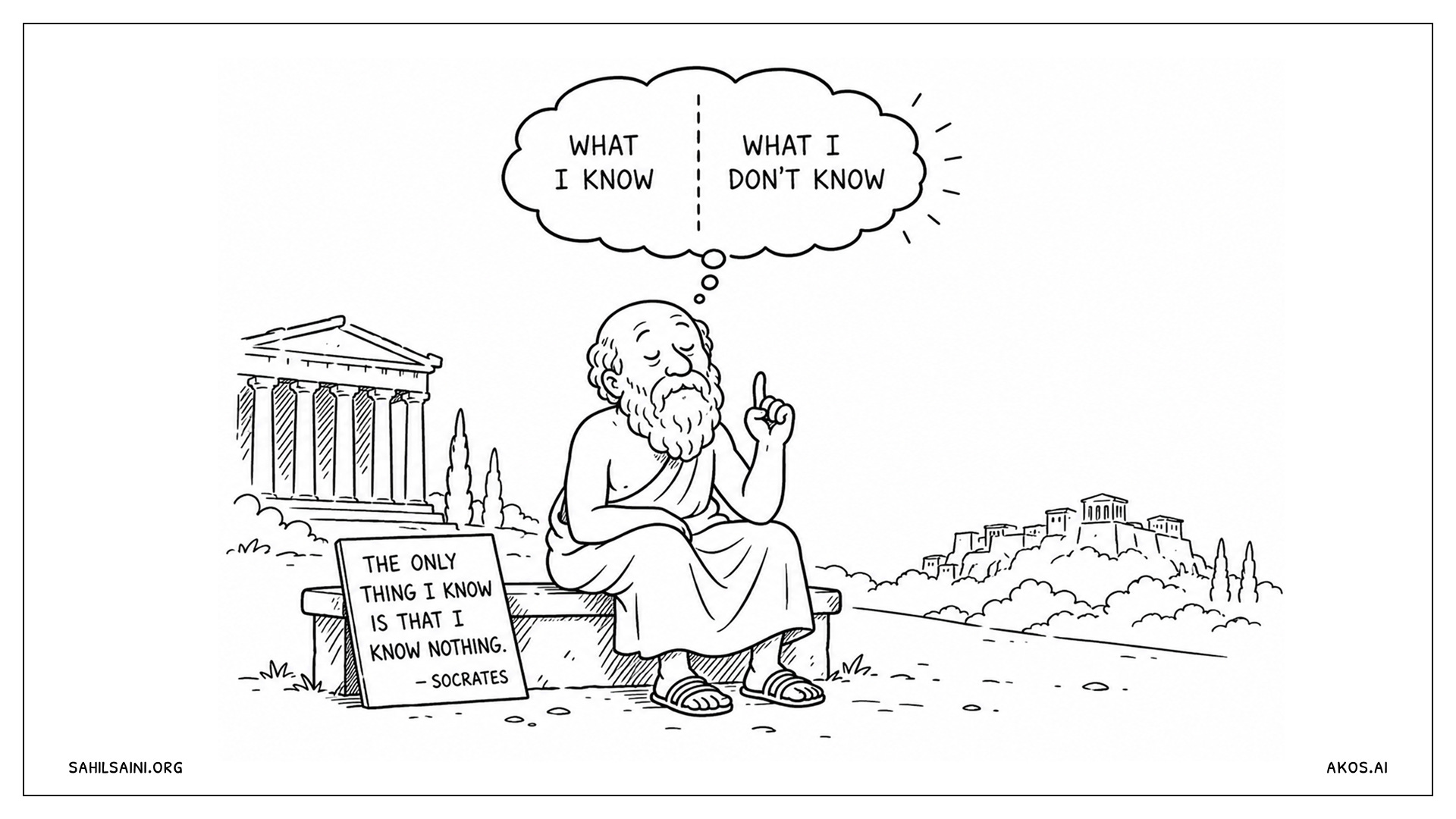
Socrates recognizing his own ignorance while others mistakenly believed themselves knowledgeable.
That’s epistemic humility.
But humility alone isn’t enough for building our model of Honest Unknown.
Much later, statistics and decision theory introduced another distinction: “…uncertainty should itself be represented rather than erased.”
Modern judgment-and-decision research calls one important version of this calibration: whether your confidence actually corresponds to how often you’re right. Overconfidence becomes dangerous, precisely because it causes us to behave as though uncertain information were settled.
Then we get another useful branch from strategic planning: known unknowns versus unknown unknowns.
The terminology became famous through Donald Rumsfeld, although the underlying distinction predates him. RAND has used the framework explicitly in reasoning and planning under uncertainty.
Put those together and we get something stronger than “know that you don’t know”:
Good reasoning ≠ having an answer
Instead:
Good reasoning = claim strength matched to evidence strength
That’s not a historical equation, just my compact representation of the idea. And this gives us our first important distinction.
An unknown is a property of the question relative to our information. An honest unknown is a property of our treatment of that question.
We could have an unknown and pretend it’s known.
Or have an unknown and correctly preserve it as unknown.
We follow the latter.
The first trap
I don’t want you walking away from Stage 1 believing that intelligent people say “I don’t know” more often.
That’s not necessarily true.
A person can hide behind uncertainty just as easily as they can hide behind certainty.
The harder discipline is:
Don’t know less than you could know.
Don’t claim to know more than you do.
And that’s exactly where we’ll start Stage 2: the taxonomy of unknowns, because “I don’t know” turns out to contain several completely different conditions that require different actions.
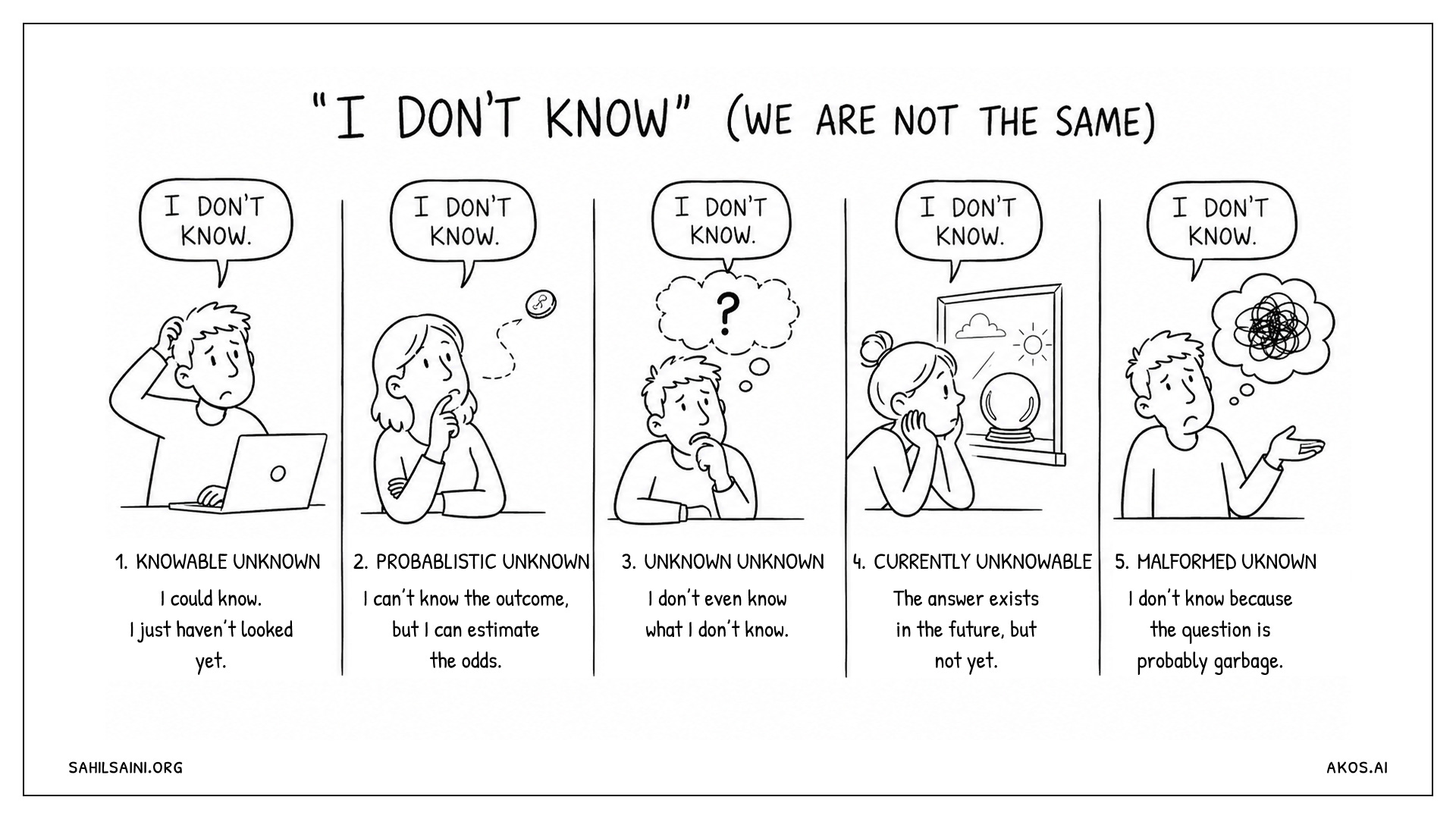
Stage 2: Not all unknowns are the same
This is where the idea becomes useful.
When someone says “I don’t know,” I think the first question should be: What kind of not-knowing is this?
Because different unknowns demand completely different behavior.
There is a formal distinction from statistics, engineering, and risk analysis that gives us a strong starting point.
NASA, for example, separates uncertainty into:
epistemic uncertainty, caused by lack of knowledge, and
aleatory uncertainty, caused by inherent variability or randomness.
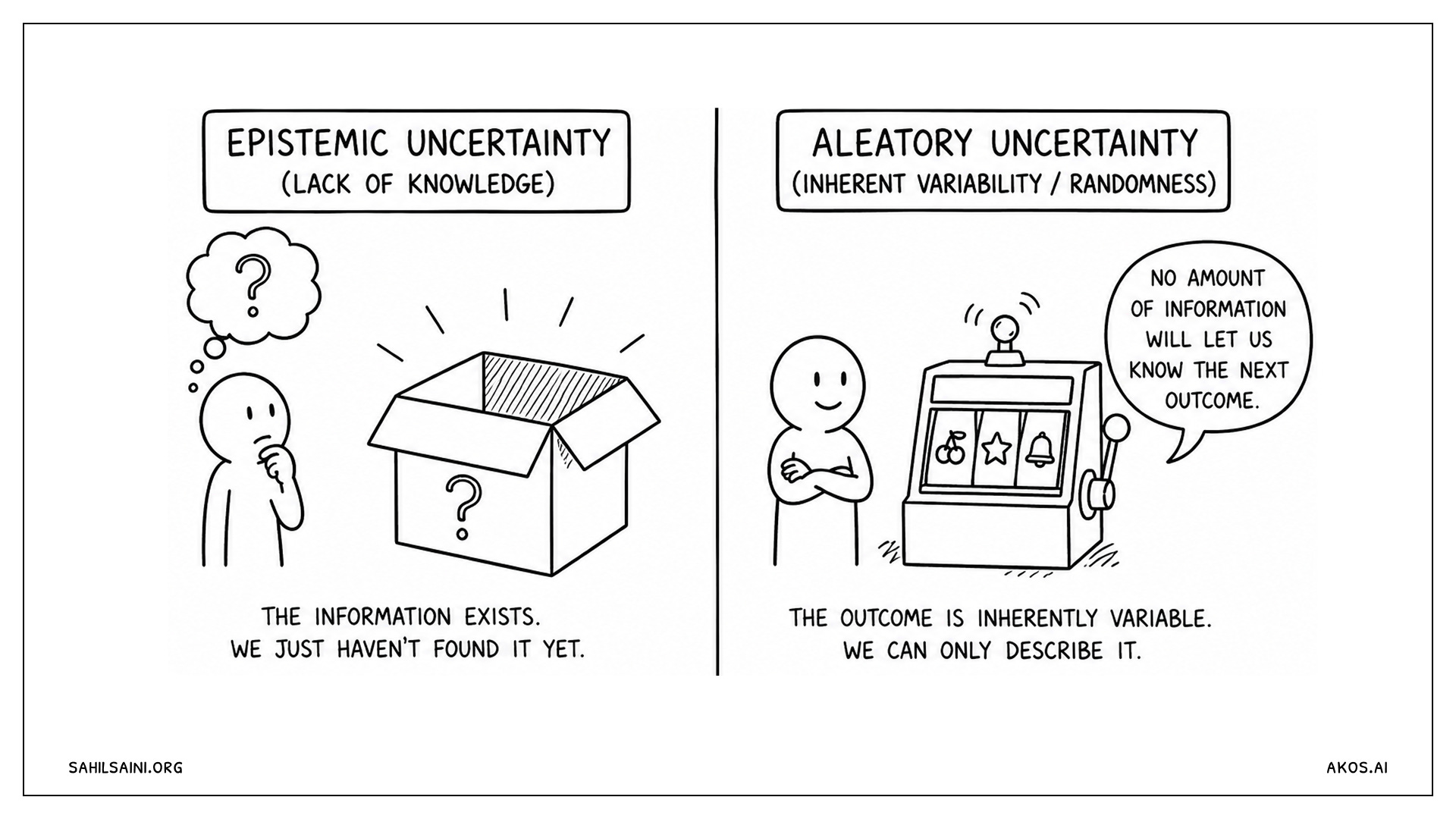
But for thinking, I want to expand that into a more useful taxonomy.
1. The knowable unknown
“I don’t know, but I could.”
You don’t know how much revenue Customer X generated last year? The information exists. You haven’t retrieved it.
You don’t know whether a competitor offers Feature Y. You could investigate.
You don’t know whether customers actually care about something. You could interview them, observe behavior, or run an experiment.
This is epistemic uncertainty. More information can reduce it.
NASA explicitly treats epistemic uncertainty this way: it represents the state of our knowledge and can shrink as information is acquired.
This is perhaps the most abused category in business.
People say: “We don’t know whether customers will pay for this.”
True.
But that doesn’t mean: “Therefore, let’s have a meeting and debate it.”
😂
It means go get or buy information.
That leads to our first operating rule:
Reducible unknown → Acquire information
2. The probabilistic unknown
“I can know the odds without knowing the outcome.”
Will a fair coin land heads? Unknown.
Can we improve our knowledge until we know what the next flip will be? No.
But we know something extremely useful:
P(H)=0.5
i.e. probability of heads is 50%
So unknown does not mean absence of knowledge. We can have considerable knowledge about something whose outcome remains unknown.
Business is full of these:
“Will this salesperson close this particular deal?”
“Will this investment outperform?”
“Will this customer churn?”
“Will this drug work for this particular patient?”
We may never be able to answer the binary question beforehand. But perhaps you can move from:
¯\(ツ)/¯
to:
“Given what we know, I’d put it at roughly 65%.”
Now we’ve transformed ignorance into calibrated uncertainty. And calibration has a precise meaning.
If you repeatedly assign 70% probability to events, roughly 70% of those events should occur. Tetlock describes exactly this property in forecasting research.
So:
Irreducible outcome uncertainty → Estimate probability
Notice what we’re not doing. We’re not forcing an answer. We’re improving the shape of the unknown.
3. The unknown unknown
“I don’t know that I don’t know.”
This is the dangerous one. Imagine you’re evaluating whether to launch a product. You have modeled:
market size
pricing
CAC
conversion
retention
engineering cost.
Beautiful spreadsheet. But there’s some variable X you haven’t even conceived of.
Maybe a regulatory constraint. Maybe distribution behaves completely differently. Maybe customers use the product for something you never anticipated.
Your model contains no cell labeled X. That means adding more precision to the existing spreadsheet doesn’t solve the problem.
You can make: Customer Acquisition Cost (CAC)
CAC = $47.31
instead of:
CAC ≈ $50 (approx)
and feel wonderfully sophisticated while completely missing the variable that kills the company.
This is where intellectual humility becomes structural rather than emotional.
You need mechanisms designed to discover variables you haven’t modeled. We’ll eventually get into those.
4. The currently unknowable
This is another category people often confuse with #3 (The Unknown Unknown).
“The answer exists eventually, but cannot presently be observed.”
Who will win the 2032 presidential election?
What will Apple’s largest product category be in 2040?
What will Bitcoin trade at on August 17, 2036?
There will eventually be an answer.
But there is no amount of Googling/GPTing today that retrieves it. You can gather evidence and create a probability distribution, but you cannot collapse it into fact.
This distinction matters because humans are extraordinarily tempted to convert:
prediction
into
knowledge.
The honest unknown says: “I have a thesis. I do not have a fact.”
5. The malformed unknown
This is my favorite category, and it’s most overlooked.
Sometimes you don’t know because the question is garbage.
🤯
“What will AI do to our company?” Impossible to answer usefully.
“What is our AI strategy?” Possibly meaningless.
“Is this a good investment?” Compared with what? At what price? Over what time horizon? Under what assumptions?
Douglas Hubbard’s work on measurement makes essentially this point:
before measuring something, clarify what decision the measurement supports, what observable thing is actually being measured, and how it affects the decision.
Often that reframing changes what should be measured in the first place.
So sometimes:
Bad question → Apparent unknown
And the correct response isn’t research. It’s reformulation.
Now we have our first working map
When we encounter: “I don’t know.”
don’t stop there. Ask:
Could the answer be obtained?
→ investigate.
Is the outcome inherently uncertain?
→ estimate probabilities.
Might important variables be outside my model?
→ search for missing assumptions.
Does the answer only become knowable in the future?
→ maintain a forecast, not a belief masquerading as fact.
Is the question itself poorly formed?
→ reformulate it.
And here’s where the research gets particularly interesting.
A 2017 Management Science paper by Walters, Fernbach, Fox, and Sloman tested something almost eerily close to what we’re calling the Honest Unknown. They found that overconfidence was substantially reduced when people were explicitly asked to consider what information was unknown or missing before stating their confidence.
It worked better than simply asking people to “consider the alternative.”
That’s a big clue.
The useful question may not be: “Am I wrong?”
It may be: “What don’t I know that would matter if I knew it?”
Those questions sound similar. They’re not.
We’ll stop here, because Stage 3 is the research behind why us humans are so bad at preserving unknowns: overconfidence, ambiguity, anchoring, narrative completion, calibration, and why intelligent/expert people can actually be especially vulnerable in certain circumstances. That’s where the psychology gets juicy.
Stage 3: Why our brains hate an honest unknown
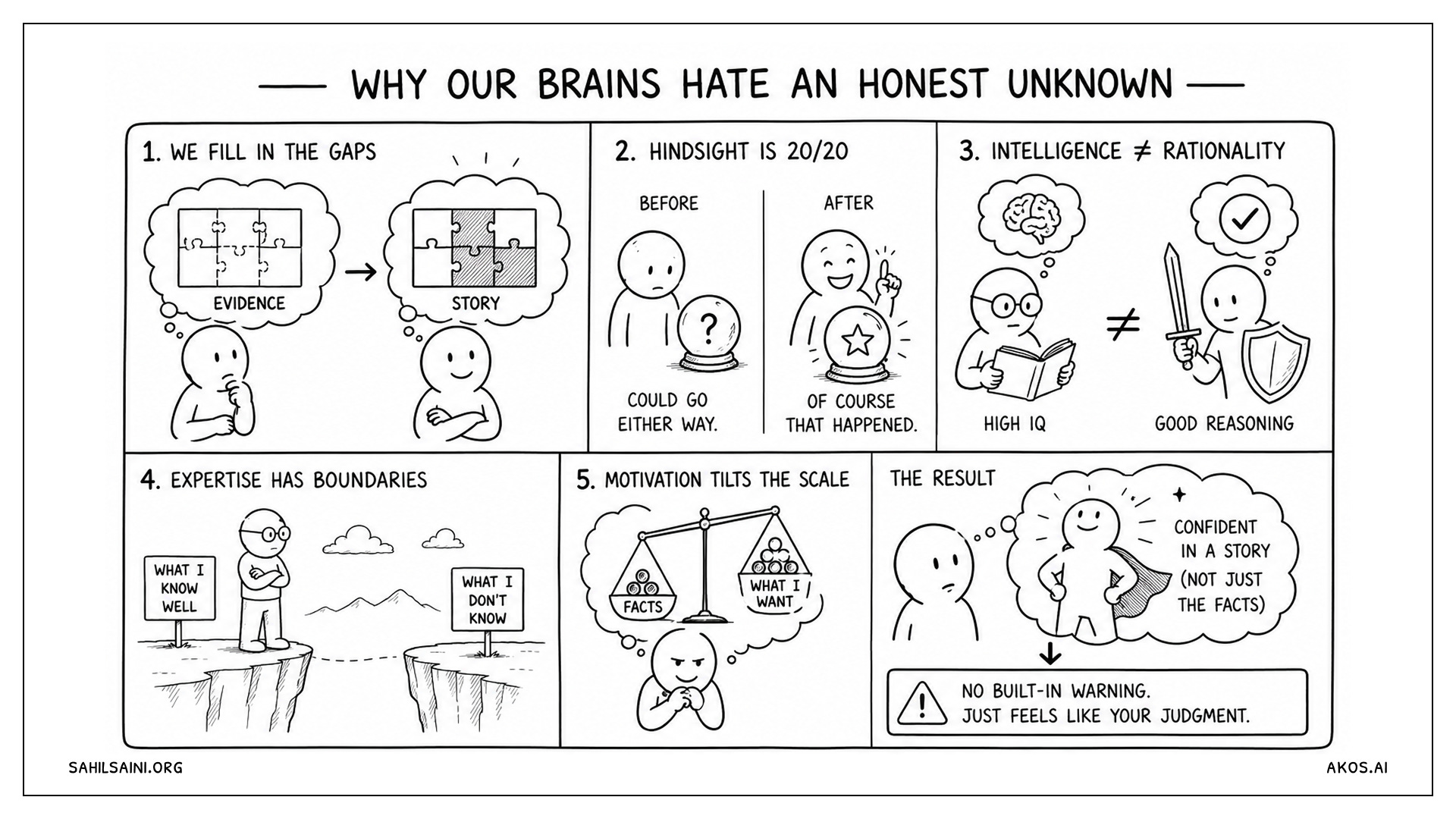
Now we get to the machinery underneath it. The Honest Unknown Principle is necessary because our human mind doesn’t naturally preserve uncertainty very well.
It tends to compress uncertainty into a story.
And once the story feels coherent, something dangerous happens:
Coherence starts masquerading as evidence.
This is one of the central themes in Daniel Kahneman’s work on judgment. He used the wonderfully ugly acronym WYSIATI: “What You See Is All There Is.”
The basic idea is that when forming judgments, we construct the best explanation from the information immediately available while often failing to adequately account for information that is absent. Kahneman connects this directly to overconfidence.
That gives us our first enemy.
1. The brain doesn’t leave empty fields empty
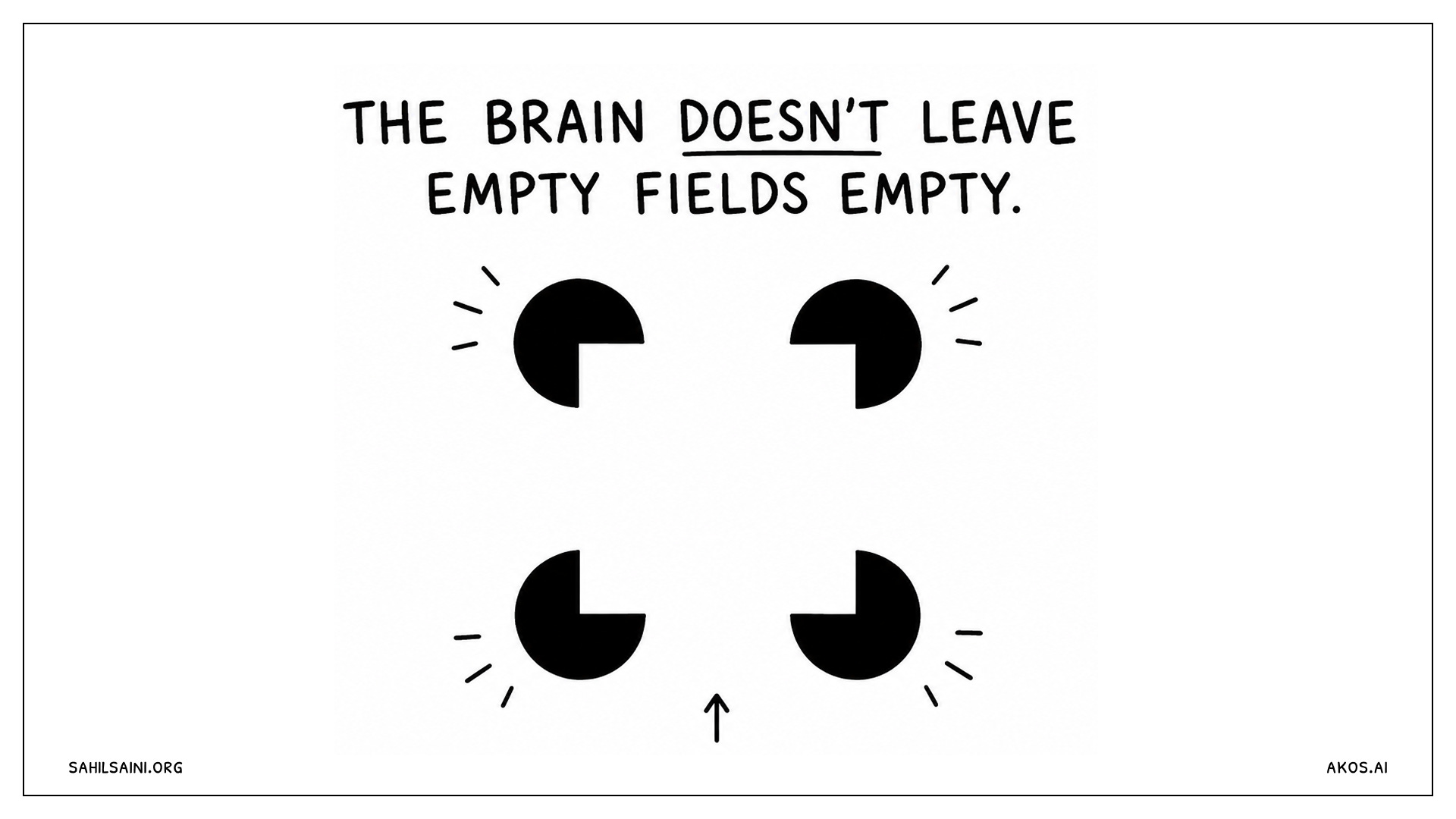
Suppose I’m considering acquiring a small software company.
I know:
Revenue: $8M
Growth: 35%
Gross margin: 78%
Founder wants out
Customers seem happy
Purchase price: $30M
I start constructing a story:
“Founder is tired… Business is healthy… Strategic buyer hasn’t noticed it… We can improve distribution… $30M might be cheap.”
Notice what happened.
I didn’t necessarily fabricate facts.
That’s much more subtle.
I connected facts.
And the connections themselves may be assumptions:
Founder wants out → probably not because something is wrong.
Customers seem happy → probably low churn.
35% growth → probably sustainable.
No strategic buyer → probably overlooked.
Every individual inference sounds reasonable.
Collectively, they create a world.
Once I can see that world clearly, my confidence rises.
But the evidence hasn’t changed.
This gives us an important distinction:
Explanatory completeness ≠ Evidentiary completeness
A story can be complete while the evidence underneath it is Swiss cheese.
2. We don’t just suffer from ignorance. We suffer from unrecognized ignorance.
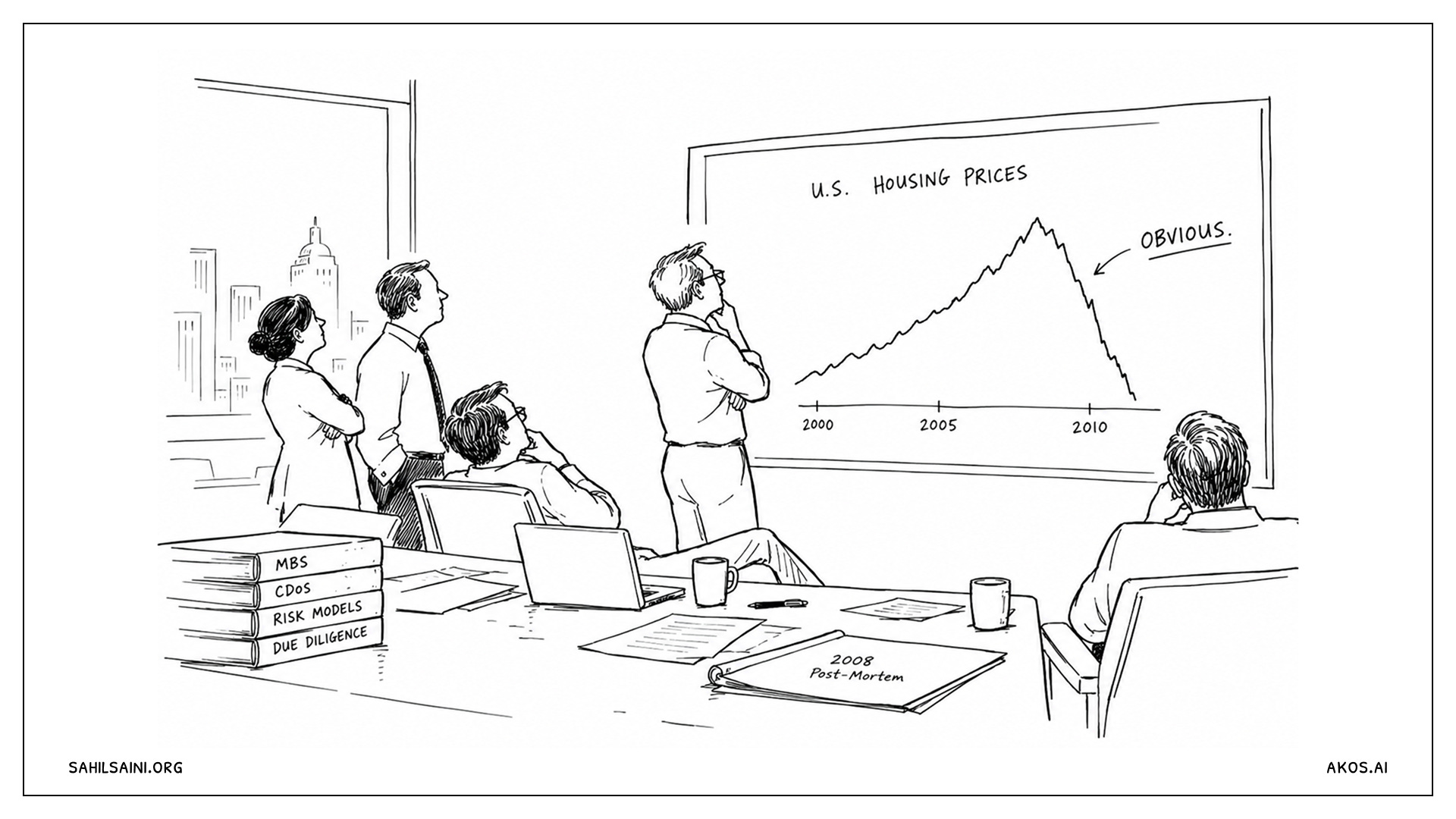
This connects beautifully to work by psychologist Baruch Fischhoff on hindsight bias.
After an event occurs, people tend to perceive that outcome as having been more predictable beforehand than it actually was.
In Fischhoff’s classic experiments, telling people which historical outcome occurred increased the probability they retrospectively assigned to that outcome.
Think about the consequence.
Before: “Could go either way.”
After: “Of course that happened. The signs were there.”
The information that didn’t predict the outcome gets mentally demoted.
The information that did gets promoted.
We rewrite uncertainty after reality resolves it.
That’s devastating if you’re trying to become a better decision-maker because:
A good outcome can teach you the wrong lesson about a bad decision.
And:
A bad outcome can teach you the wrong lesson about a good decision.
If I make a 90% probability bet and lose, that doesn’t prove my reasoning was bad.
If I make a 10% probability bet and win, that doesn’t prove I’m a genius.
So we need to preserve what we knew at the time.
Remember this. It becomes important when we build our checking system.
3. Intelligence doesn’t automatically save you
This is one of the most interesting parts.
You might assume:
More intelligence → better reasoning → fewer false beliefs
❌ (wrong)
Unfortunately, reality is messier.
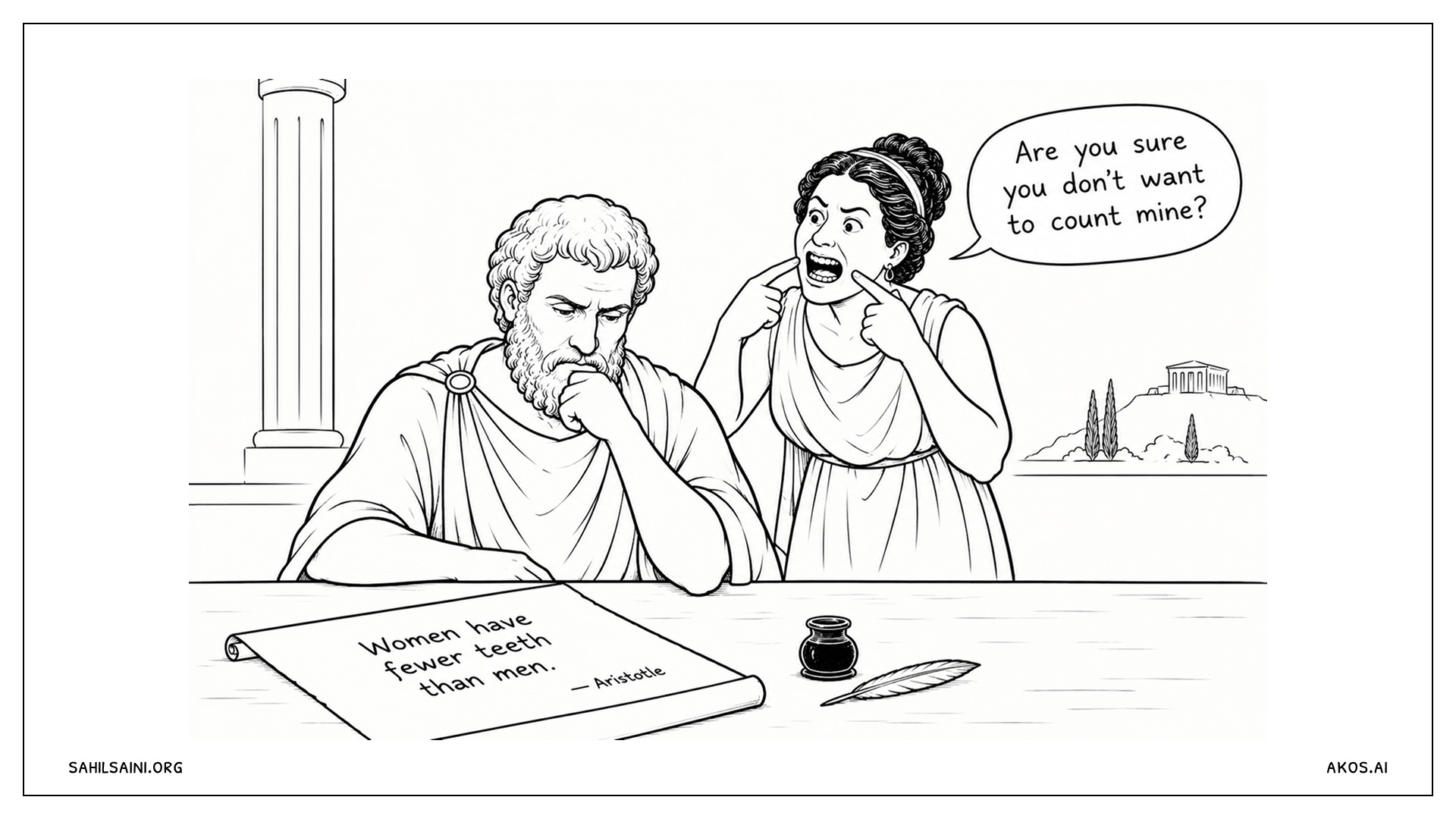
Keith Stanovich and colleagues have spent decades distinguishing intelligence from rational thinking.
Cognitive ability helps enormously, but many rationality errors aren’t eliminated simply by being intelligent.
There’s a nasty implication here.
A highly capable thinker may sometimes be better equipped to defend a conclusion they’ve already reached.
More intelligence gives us a larger rhetorical and analytical arsenal.
So intelligence can be used for:
Evidence → Conclusion ❌
but also:
Conclusion → Sophisticated justification ❌
Those are completely different processes.
That’s why the Honest Unknown isn’t fundamentally an IQ problem.
It’s a discipline problem.
4. Experts have another problem: the domain boundary
Expertise is enormously valuable inside environments where expertise is actually predictive.
Kahneman and Gary Klein, who came from rather different traditions of decision research, published a fascinating joint paper on when expert intuition can be trusted.
Their conclusion wasn’t “intuition is good” or “intuition is bad.”
Expert intuition becomes reliable when two conditions exist:
The environment contains sufficiently regular patterns, and the person has had enough opportunity to learn those patterns through feedback.
Chess?
High validity.
Experienced chess players repeatedly encounter patterns and receive rapid feedback.
Long-term stock-market prediction?
Far uglier.
Feedback is noisy. Causality is ambiguous. Regimes change.
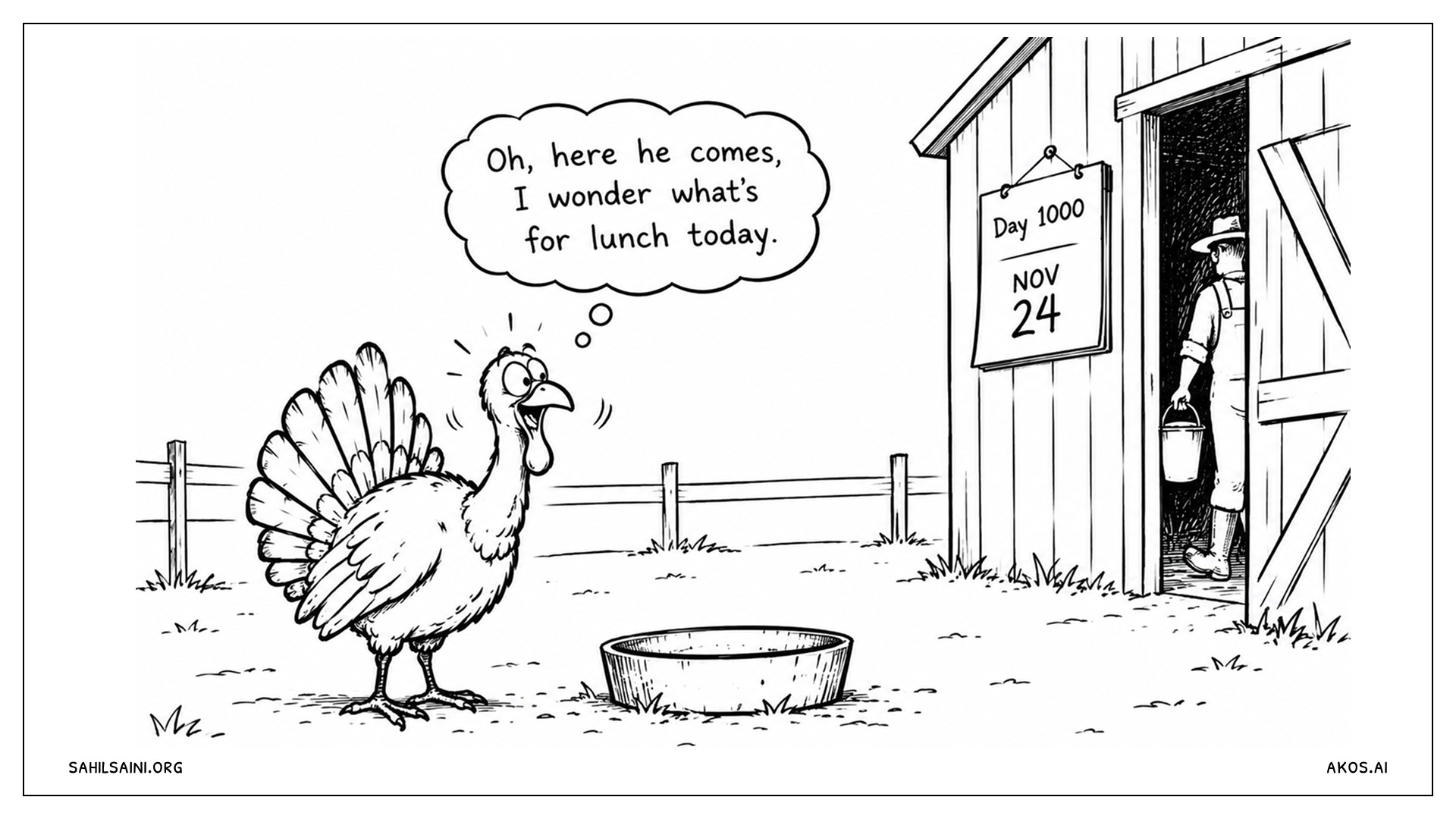
Now imagine someone who has spent twenty years successfully building software companies.
They probably have genuine expertise.
But then:
“I’ve built companies for twenty years. I know this market will develop this way.”
Hold on.
You’ve crossed a boundary.
Your expertise may justify confidence about:
engineering organizations,
product development,
hiring,
sales processes.
It may not justify the same confidence about:
interest rates,
geopolitics,
regulation,
consumer psychology five years from now.
The dangerous sentence is:
“I’ve seen this before.”
Sometimes you have.
Sometimes you’ve seen something that rhymes just enough to seduce you.
5. Then there’s motivated reasoning
Now we add gasoline.
Sometimes we aren’t neutral about the answer.
You want the acquisition to work.
You own the stock.
You hired the executive.
You built the product.
You publicly predicted something.
Now evidence doesn’t enter an empty courtroom.
The defendant already has a lawyer.
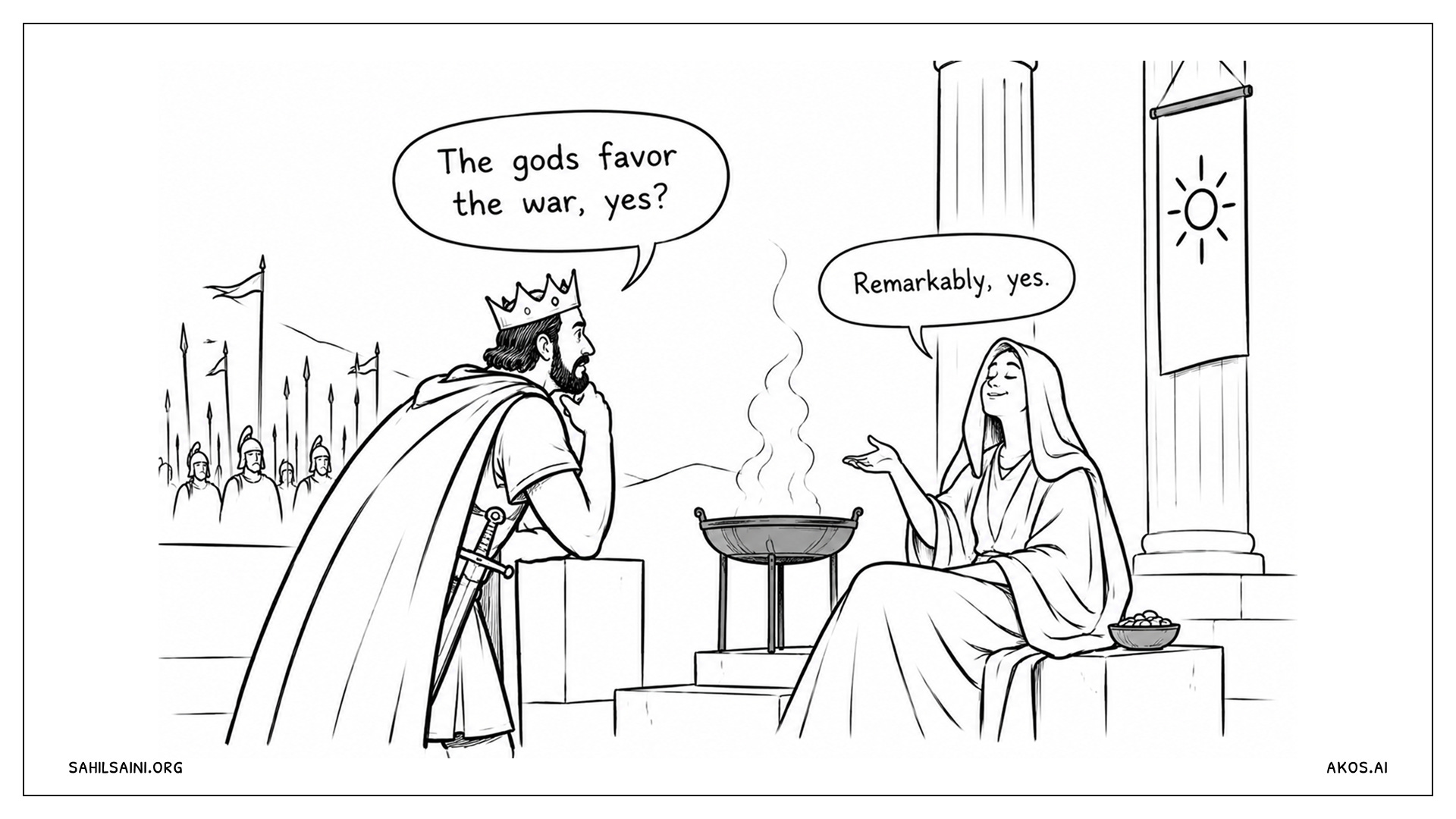
Research on motivated reasoning, particularly associated with Ziva Kunda, shows how people’s goals can influence the cognitive processes they use to evaluate evidence and reach conclusions.
People don’t necessarily consciously decide to deceive themselves. Rather, reasoning can become selectively recruited toward conclusions they prefer, provided those conclusions can still be justified. Cherry-picking.
That’s much scarier than lying.
A liar knows the truth and says something else.
A motivated reasoner can genuinely believe they’ve evaluated the evidence objectively.
So here’s our emerging model
When reality gives us:
Evidence + Missing Information
our brains don’t reliably preserve that state.
They tend to do something closer to:
Evidence + Assumptions + Narrative + Motivation → Confidence
And the output doesn’t come labeled:
WARNING: 37% OF THIS CONCLUSION WAS FILLED IN BY YOUR BRAIN.
😂
It just feels like your judgment.
That is why I don’t think the Honest Unknown Principle should ultimately be about humility.
But…“Be humble” is weak operational advice.
We can’t inspect our brains and turn the humility knob from 6 to 8.
Instead, we need to externalize uncertainty.
We need a method that forces:
facts to remain facts,
inferences to identify themselves as inferences,
assumptions to expose themselves as assumptions,
unknowns to remain visibly unknown,
and predictions to carry probabilities rather than disguising themselves as facts.
And I think this is where we’re going to turn the concept into something genuinely useful: a practical protocol for making decisions under uncertainty.
Not a 27-item checklist. Something compact enough that we could actually run it mentally during an investment decision, strategy meeting, product bet, acquisition, hiring decision, or argument.
Stage 4: Turning the Honest Unknown into an operating method
Now we stop admiring the philosophy and make it earn rent.
I think the mistake would be creating an “Honest Unknown Framework™” with twelve boxes. You’d use it twice and then it would fossilize in Notion. We’ll still do that, but later…
Instead, I want to derive something small enough to become instinct.
Start with any consequential claim: “I think X.”
Before acting on X, interrogate it through four moves.
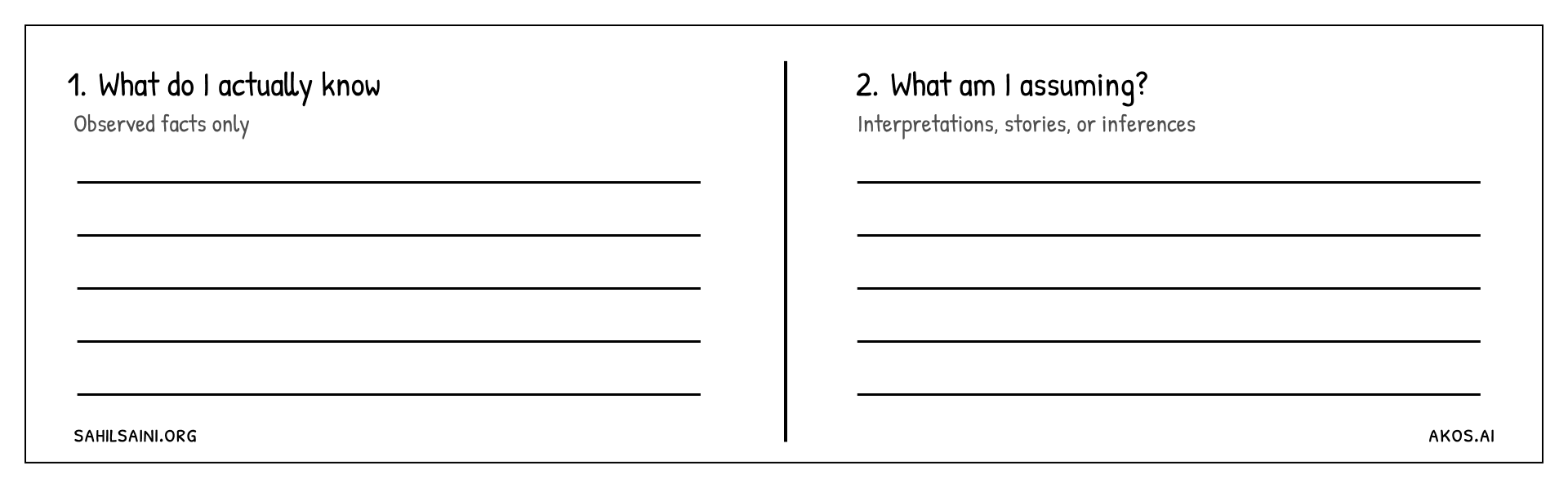
1. Separate what we know from what you infer
Imagine:
“This competitor is struggling.”
What do I actually know?
Revenue growth fell from 40% to 12%.
They laid off 18% of staff.
The founder stepped down.
Three senior salespeople left.
Those are observations.
Then comes:
“They’re struggling.”
That’s an inference.
Maybe it’s an excellent inference.
But it still belongs in a different bucket.
This distinction sounds almost insultingly simple. In practice, it’s incredibly powerful because normal speech quietly erases it.
We say:
“Customers don’t want this.”
when what we actually observed was:
“Nine of twelve customers didn’t use it within 30 days.”
The first is an explanation.
The second is evidence.
So our first discipline becomes:
Observation ≠ Interpretation
Don’t eliminate interpretation. Label it.
2. Ask the Honest Unknown question
Once you’ve formed your thesis, don’t ask:
“Why might I be wrong?”
That’s useful, but I think there’s a better question:
What would I want to know before being allowed to become more confident?
Notice the framing.
You’re not trying to destroy your thesis.
You’re identifying missing information with decision value.
Suppose you’re considering investing in Company X.
You know:
Revenue growing 60%.
Margins improving.
Large TAM.
Management sounds excellent.
Valuation looks reasonable.
You’re bullish.
Now:
What would I want to know before being allowed to become more confident?
Maybe:
How much growth comes from one customer?
What does retention look like by cohort?
How much revenue is usage-based?
What happens to margins if inference costs don’t decline?
Are competitors seeing similar growth?
Why are insiders selling?
Now we’ve found the interesting territory.
Not:
“What don’t I know?”
That’s infinite.
You don’t know the CEO’s favorite sandwich either. 🥪
We care about:
Unknown × Decision relevance
Some unknowns are irrelevant.
Some can flip the decision.
Those are critical unknowns.
3. Ask the most important question: Can I collapse this unknown?
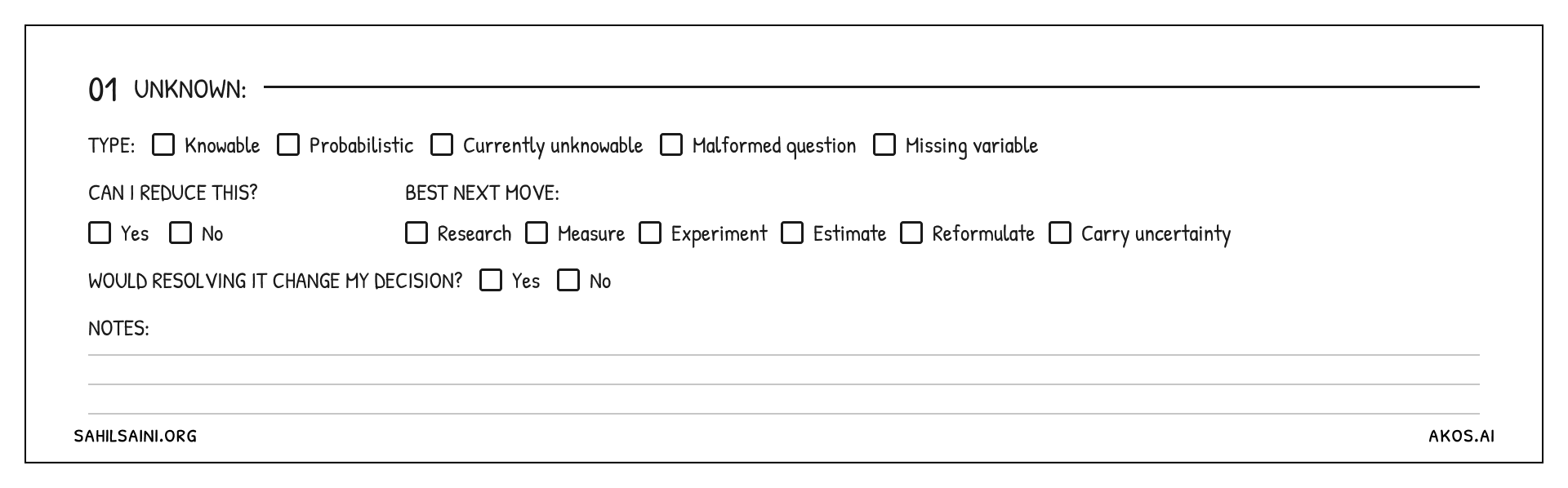
Take each critical unknown and classify it using Stage 2.
Suppose your question is:
“I don’t know whether customers are retaining.”
Can you know?
Yes.
Find cohort data.
So:
Unknown → Research
But if the question is:
“I don’t know whether this market will be worth $50B in 2032.”
You cannot retrieve the 2032 answer.
So stop treating additional research as though eventually Google will reveal the future.
Instead:
Unknown → Probability / scenario
And if it is:
“I don’t know how customers will react to $99 pricing.”
Maybe research helps.
But perhaps the cheapest information source is reality:
Unknown → Experiment
Ask them or simply charge a few $99. See what happens.
This connects to a real concept from decision theory called Value of Information, which very roughly means:
information is valuable when having it can change the decision you would make.
Formal decision analysis asks how much better your expected outcome would be if particular uncertainty were resolved before choosing.
That gives us a gorgeous little rule:
Don’t research what won’t change the decision.
You could spend three weeks improving your confidence from:
73% → 76%
when either probability produces exactly the same action.
That’s intellectual procrastination dressed in a lab coat.
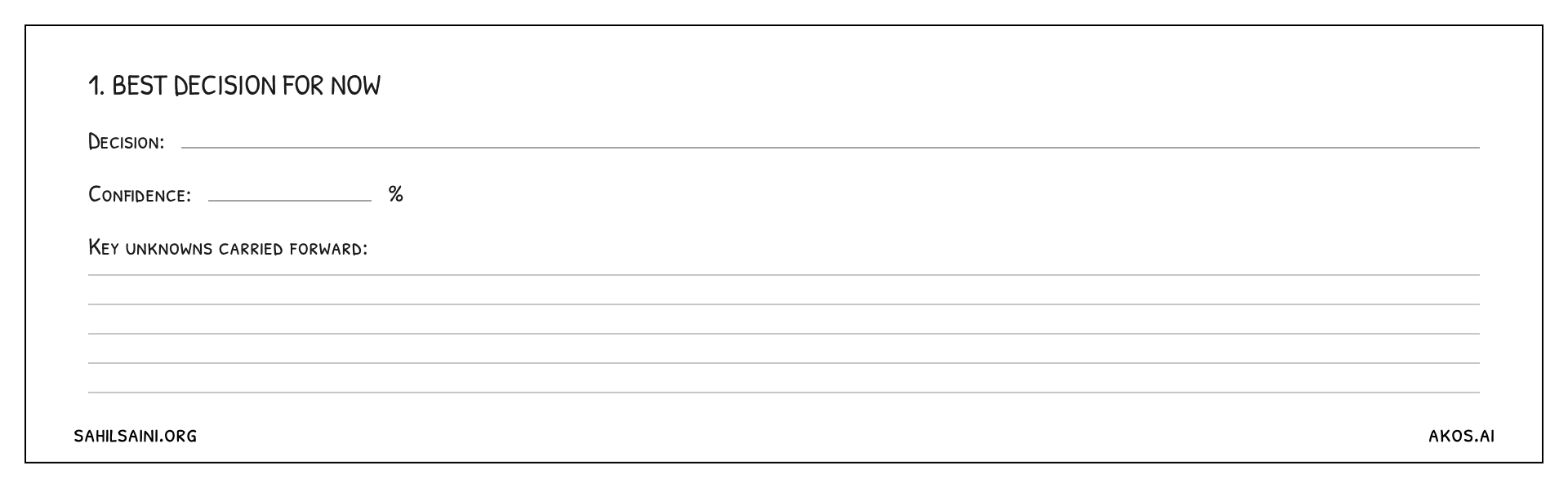
4. Finally: state the decision without killing the unknown
This is the part I care about most.
Eventually, we have to act.
We cannot preserve uncertainty forever.
Suppose you’ve done everything above and arrive at:
“I think we should launch.”
The temptation is to mentally transform that into:
“Launching is the right decision.”
Don’t.
Instead:
“Given what we know, launching is the best decision. I still don’t know X and Y.”
That’s a fundamentally different intellectual posture.
You have separated:
Decision confidence ≠ Outcome certainty
We can be highly confident in the decision while remaining uncertain about the outcome.
This distinction is huge.
Consider poker
You hold pocket aces pre-flop.
Your opponent goes all-in with 7♣ 2♦.
You call.
Excellent decision.
Then the board comes:
7♥ 2♠ 9♣ 4♦ K♠
You lose.
Was calling wrong?
Of course not.
The outcome was uncertain.
The decision wasn’t arbitrary.
This is why Annie Duke’s work on decision-making uses poker so effectively: decision quality and outcome quality must be separated when luck is involved.
And this brings us somewhere surprisingly deep.
The goal of the Honest Unknown Principle is not to reduce uncertainty to zero.
That’s impossible.
The goal is:
Reduce uncertainty until additional certainty no longer changes the action.
Then act. That’s very different from:
“Wait until we know.”
And equally different from:
“We know enough.”
The first can create paralysis.
The second can conceal recklessness.
So our mental protocol is becoming very small
You believe X.
Ask: What do I actually know?
Separate observation from interpretation.
Then: What would I want to know before allowing myself greater confidence?
Identify critical unknowns.
Then: Can I cheaply reduce any of them?
Research, measure, experiment, or estimate.
Then: Would resolving this unknown change my decision?
If no, stop researching.
If yes, keep going.
And eventually:
Make the best decision available while explicitly carrying the remaining unknowns forward.
That last part matters.
Because the unknown doesn’t disappear when the meeting ends. It becomes something we can watch.
And that takes us directly into Stage 5: the audit.
This is where we’ll build ways to catch yourself after you’ve formed a strong conviction, especially when you really like your thesis.
We’ll look at falsifiability, disconfirming evidence, premortems, prediction logs, confidence calibration, and one particularly powerful question:
“What would have to be true for me to change my mind?”
That is where Honest Unknown starts becoming a defense against your own intelligence.
Stage 5: How do you check yourself?
Now assume the dangerous case. You’ve done the research. You’ve separated facts from inference. You’ve identified unknowns.
And you still have a strong thesis.
The problem now isn’t ignorance. It’s attachment.
Once I believe X, my brain becomes very good at making new information compatible with X.
So we need something stronger than: “I’ll stay open-minded.”
Open-mindedness is an intention. We need tripwires.
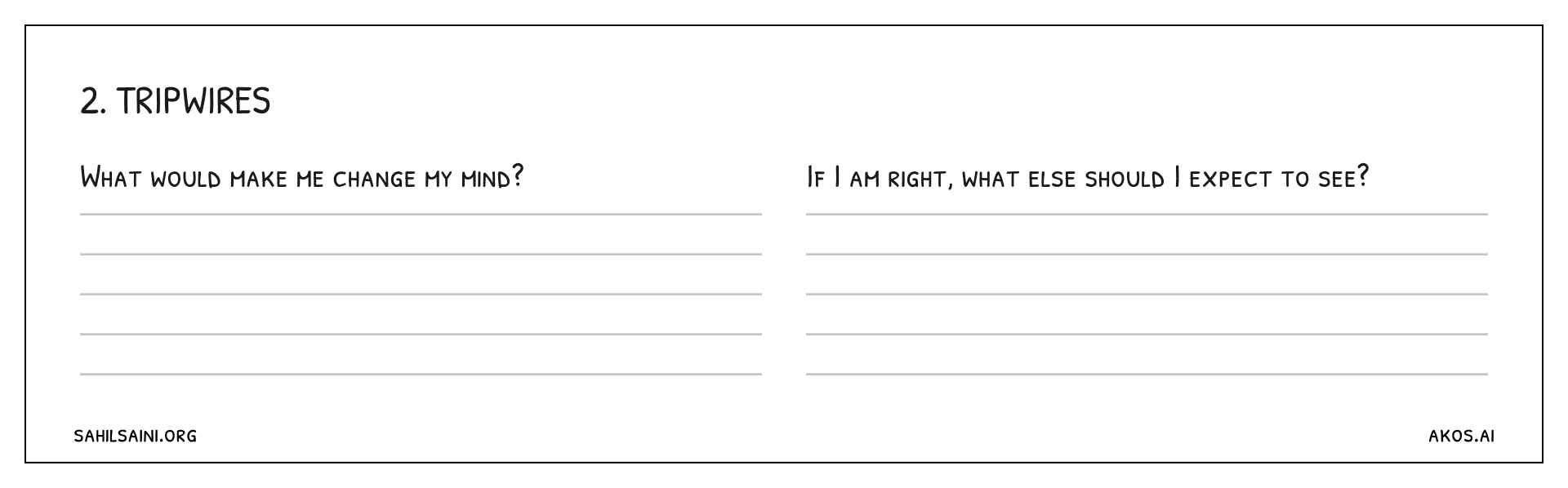
1. Define what would change your mind before reality happens
Suppose your thesis is: “This company is undervalued because the market is underestimating its AI business.”
Before investing, write:
I would materially weaken this thesis if...
Maybe:
AI revenue growth falls below 20% for two consecutive quarters.
Gross margins deteriorate despite revenue growth.
The supposed AI growth turns out to be mostly cannibalization.
A competitor demonstrates materially better economics.
Management changes how it defines or reports the segment.
Now something important has happened.
You’ve made your belief falsifiable.
Karl Popper made falsifiability famous in philosophy of science. His deeper point was about distinguishing scientific theories from claims that could accommodate essentially any observation.
We can steal the useful part for ordinary reasoning:
If no imaginable evidence could weaken your belief, you don’t have a thesis. You have a commitment.
That’s our first tripwire.
2. Separate the thesis from the position
This matters enormously in investing, strategy and leadership.
Before buying:
“At $40 this stock is undervalued.”
After buying:
“My stock is undervalued.”
One word changed.
My.
Now selling doesn’t merely mean updating a forecast.
It means admitting I was wrong.
That introduces ego, sunk cost, public consistency and loss aversion.
The position begins defending the thesis.
So:
Ownership should not increase evidentiary weight
If anything, once you have skin in the game, your standard for checking yourself should rise.
This generalizes far beyond stocks:
my hire
my company
my strategy
my product
my prediction
The possessive pronoun is epistemically expensive. 😄
3. Run a premortem
Gary Klein popularized a wonderfully simple technique called the premortem.
Instead of asking:
“What could go wrong?”
Imagine something stronger:
“It’s two years from now. This decision was a disaster. What happened?”
Research by Klein and colleagues connects prospective hindsight of this sort with identifying explanations that ordinary forecasting may overlook.
The psychological trick is clever.
“What could go wrong?” makes failure hypothetical.
“It failed. Why?” makes your brain explain an observed world.
Suddenly you get:
“Our largest customer built it internally.”
“Inference costs never came down.”
“The regulatory exemption disappeared.”
“Our sales cycle was 14 months instead of six.”
“The technical advantage became commoditized.”
Some of those possibilities were previously unknown unknowns.
The premortem drags them into:
Unknown Unknown → Known Unknown
That’s epistemic progress even though you haven’t learned a new fact.
You’ve discovered a new question.
4. Keep a decision record, not just an outcome record
Remember hindsight bias from Stage 3.2?
This is the antidote.
Before an important decision, preserve:
What I believe.
Why I believe it.
What I know.
What I’m assuming.
What I don’t know.
What probability I’d assign.
What would change my mind.
Then leave it alone.
Six months later, don’t ask:
“Did I win?”
Ask:
“Was my model of the world well calibrated?”
Suppose you make ten decisions that you believe each have roughly a 70% probability of succeeding.
Seven work. Three don’t.
Those three failures aren’t necessarily evidence of poor judgment.
In fact:
You hit a 10 on 10 (100%)
success on repeated genuinely 70% propositions would eventually make me suspicious that you’re understating your confidence.
Good uncertainty should sometimes produce surprises.
That’s what probability means.
This is precisely why Philip Tetlock’s forecasting research is so interesting. In the Good Judgment Project, forecasters made explicit probabilistic predictions that could later be scored and calibrated. Research emerging from the project found that some people consistently became remarkably good forecasters, and that forecasting skill could be improved through techniques including training, aggregation and active updating.
We don’t improve judgment merely by thinking harder.
You need feedback against predictions you actually made.
Otherwise hindsight quietly edits the history.
5. Now we get to my favorite audit question
Most people ask:
“What evidence supports my thesis?”
Better thinkers ask:
“What evidence contradicts my thesis?”
But I want you to go one step further:
What evidence should exist if my thesis were true, but doesn’t?
That’s a different beast.
Suppose I say:
“Customers absolutely love our product.”
Okay.
If that’s true, what else should I expect to observe?
High retention.
Organic referrals.
Usage expansion.
Customers complaining when service goes down.
Some willingness to pay.
Maybe competitors copying features.
If none of those things exist, that’s interesting.
You’re no longer merely looking for contradictory evidence.
You’re looking for missing expected evidence.
Formally, this touches Bayesian reasoning.
If hypothesis (H) predicts evidence (E), then observing (E), or conspicuously not observing it, should affect how much credence we give (H).
Bayes’ theorem gives us:
H (Hypothesis) - Q: “Is my idea true?”
E (Evidence) - Q: “What did I observe?”
P(H) (Prior probability) - Q: “Before seeing this evidence, how likely did I think my idea was?”
P(E \mid H) (Likelihood) - Q: “If my idea were true, how likely would I be to see this evidence?”
P(E) (Overall probability of the evidence) - Q: “How often would I see this evidence for any reason?”
P(H \mid E) (Posterior probability) - Q: “After seeing the evidence, how likely is my idea now?”
You don’t need to calculate this numerically every time.
The conceptual habit is enough:
“If I were right, what else should the world look like?”
Then look at the world.
6. The stopping rule
There’s one final trap.
Once you learn all this, you can become the guy who perpetually finds another uncertainty.
Every decision becomes:
“But have we considered...”
Eventually your epistemic rigor turns into sophisticated cowardice.
So you need a stopping condition.
I proposed this in Stage 4:
Keep reducing uncertainty while it has decision value.
Once further information is unlikely to change your action enough to justify its cost:
Stop.
Make the decision.
Carry the remaining uncertainty.
Watch the tripwires.
Update when reality changes.
That last one is crucial:
Update when reality changes.
A good thinker doesn’t need their original thesis to survive.
They need their reasoning process to survive contact with reality.
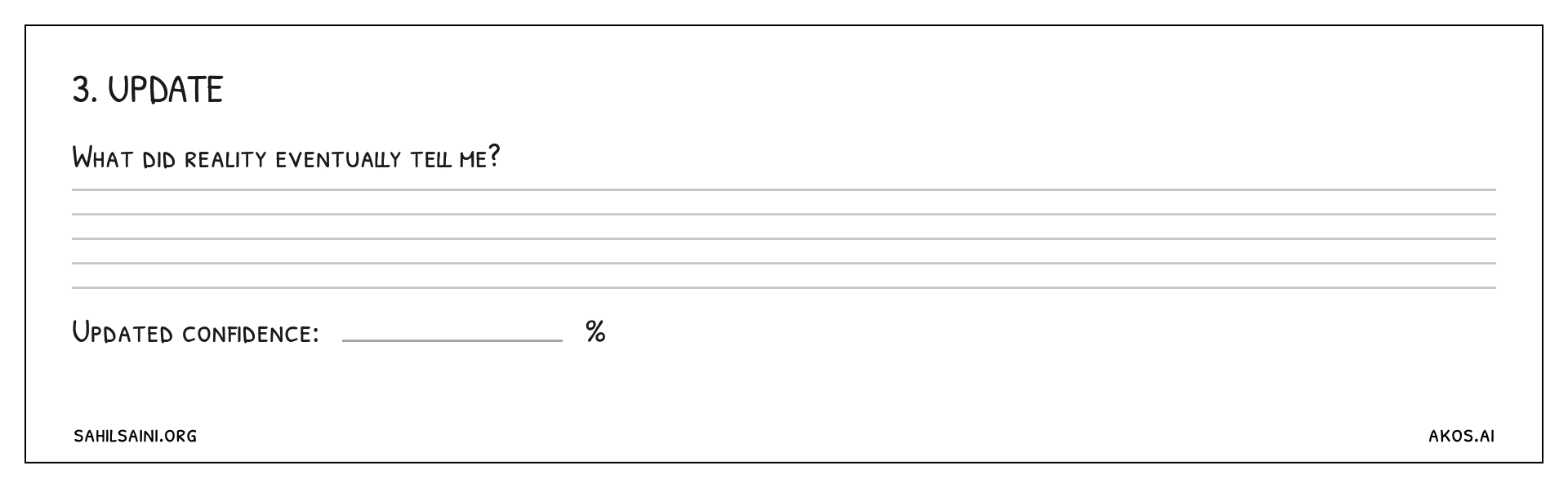
So now we have a loop
We started Stage 4 with a belief:
Claim
We separated:
Evidence | Interference | Unknowns
We reduced valuable unknowns.
We acted.
Now Stage 5 adds:
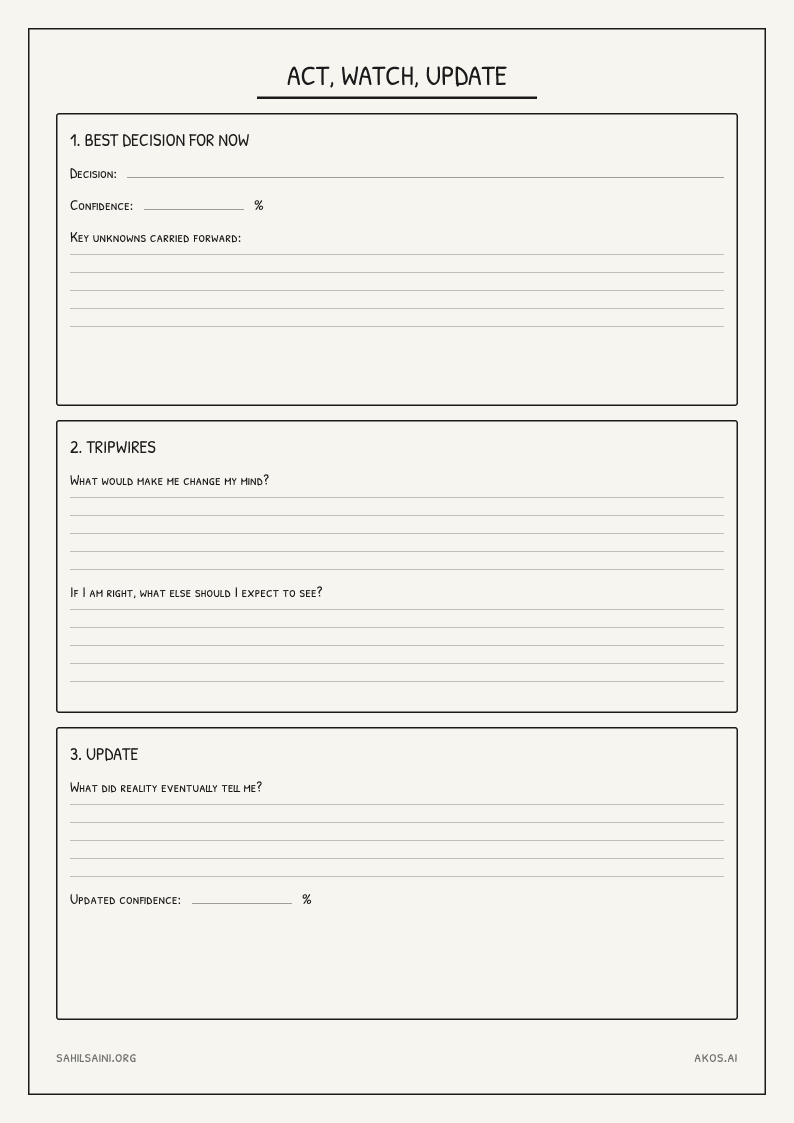
Prediction → Tripwires → Observation → Update
And then the whole thing starts again.
The Honest Unknown isn’t therefore a state of saying:
“I don’t know.”
It’s a continuous relationship between belief and evidence.
Now, we’ve accumulated enough pieces. Let’s derive our framework from first principles.
We’ll temporarily throw away Socrates, Kahneman, Tetlock, Popper, Klein, Bayes, and even the phrase Honest Unknown.
Let’s start with reality itself and ask:
If I knew absolutely nothing about epistemology, what must logically be true about making decisions in a world where my information is incomplete?
Then we’ll derive a small set of axioms from scratch.
And from those, I think we can arrive at our version of the principle, including what it means, when you invoke it, and potentially a compact formulation you could carry around as part of your broader first-principles thinking.
Stage 6: Build it from first principles
Start with the world.
Axiom 1: Reality exists independently of what I believe about it
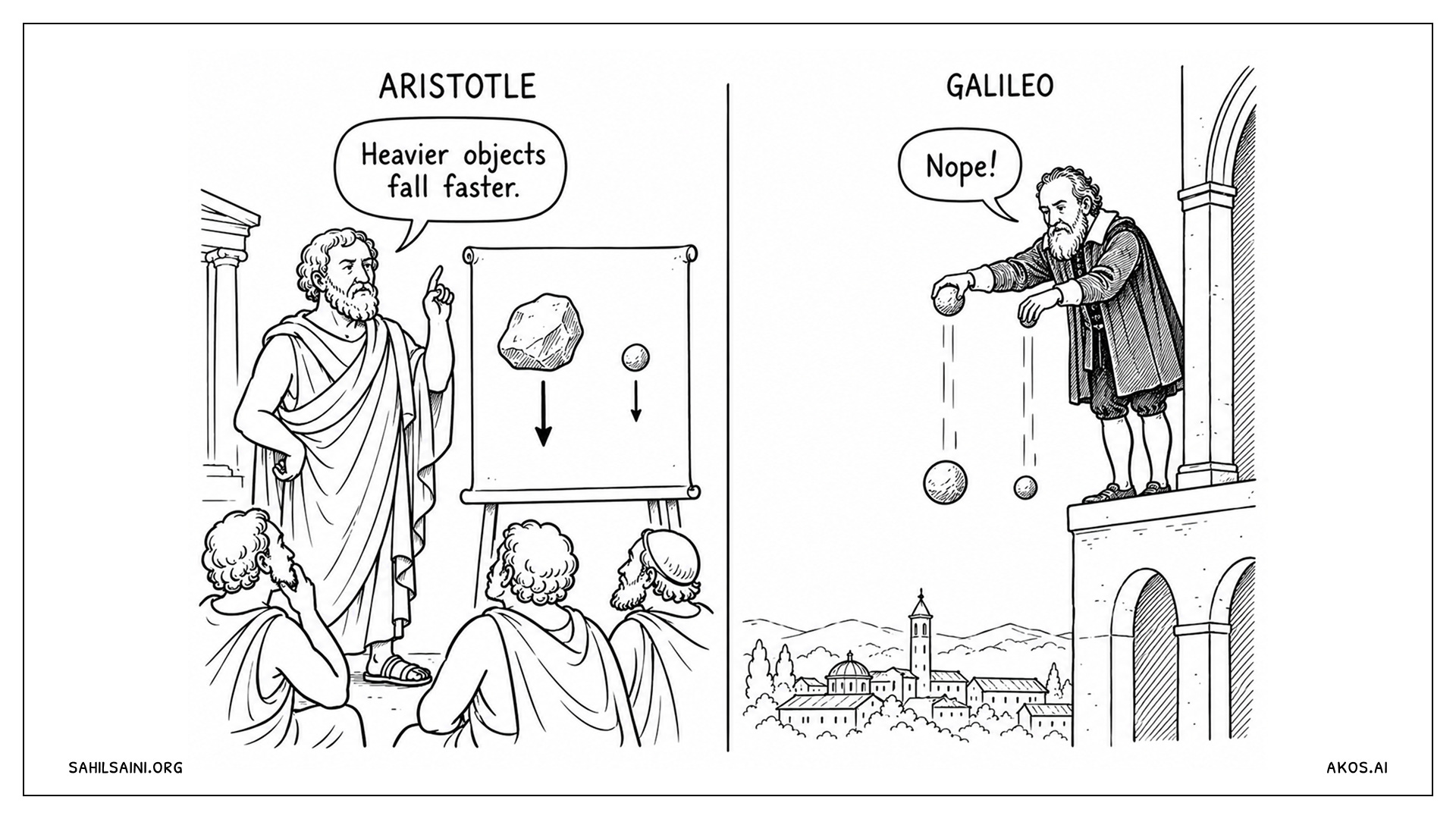
Suppose a company has $4 million of cash.
I believe it has $10 million.
My confidence doesn’t create another $6 million.
Obvious, but foundational:
Reality ≠ My model of reality
Everything we think you “know” is actually mediated through a model.
We don’t possess reality.
We possess information about reality.
That gives us:
R = reality
M = my model of reality
The goal of reasoning isn’t:
M = a convincing story (this is wrong)
It’s:
M ≈ R (approx)
Being wrong isn’t the fundamental failure.
Our models will inevitably be wrong in places.
The failure is refusing to modify (M) when (R) gives you contrary information.
Axiom 2: My information about reality is always incomplete
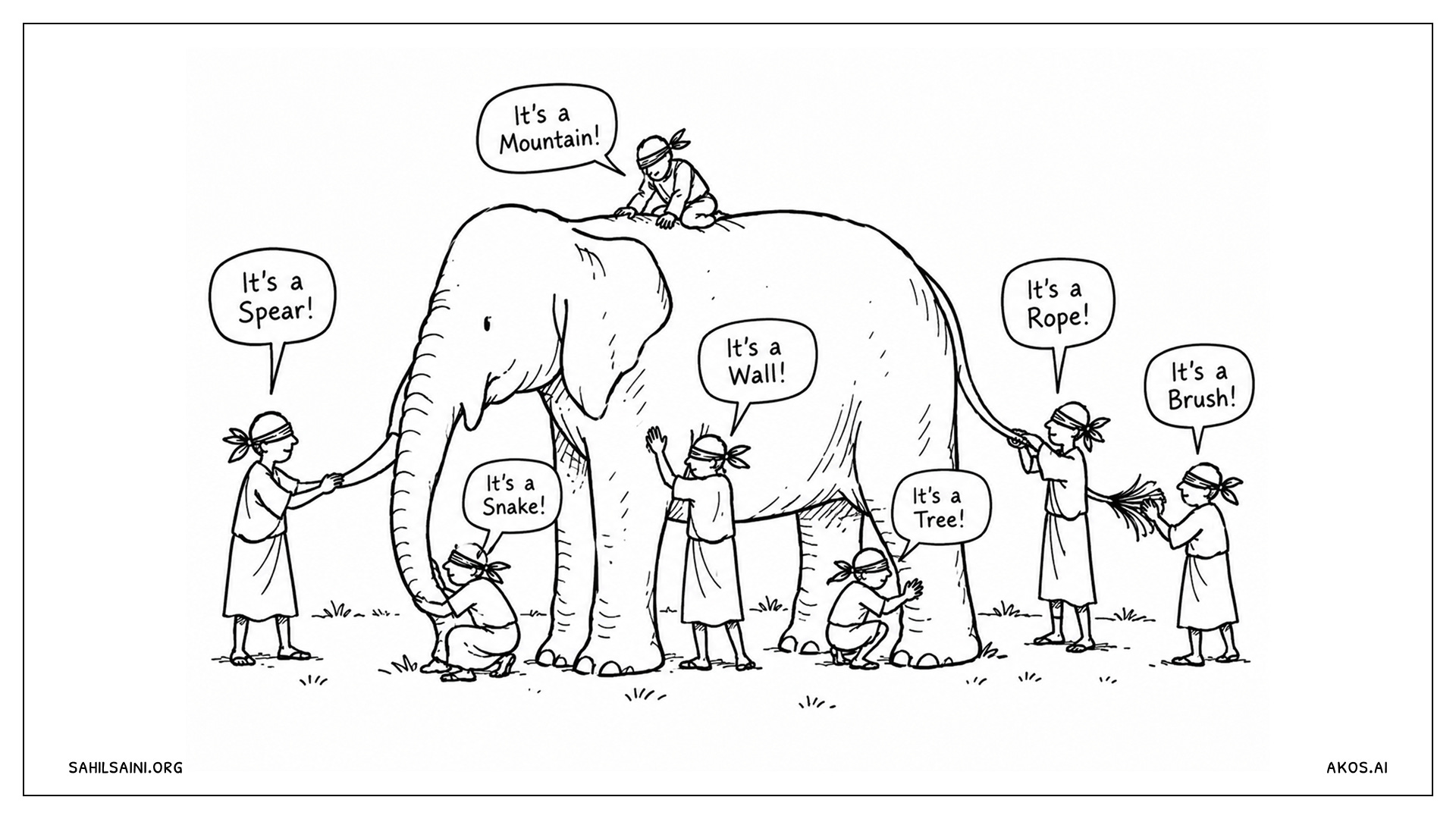
For almost every meaningful decision, we possess only some subset of relevant information.
IR = everything potentially knowable about reality
IM = what we currently know
Then necessarily:
IM ⊂ IR i.e. what we know is a subset of everything knowable about reality
Then, the gap is:
U = IR - IM
Our unknown (U).
But here’s the problem.
We don’t necessarily know the contents of (U).
That’s why:
“I’ve listed everything I don’t know.”
is logically suspicious.
If we could enumerate everything inside the unknown, it wouldn’t really be entirely unknown anymore.
So uncertainty isn’t a bug we eventually eliminate.
It’s structural.
That immediately kills one fantasy.
Perfect information cannot be the prerequisite for action.
Otherwise we’d barely act at all.
Axiom 3: Decisions must nevertheless be made
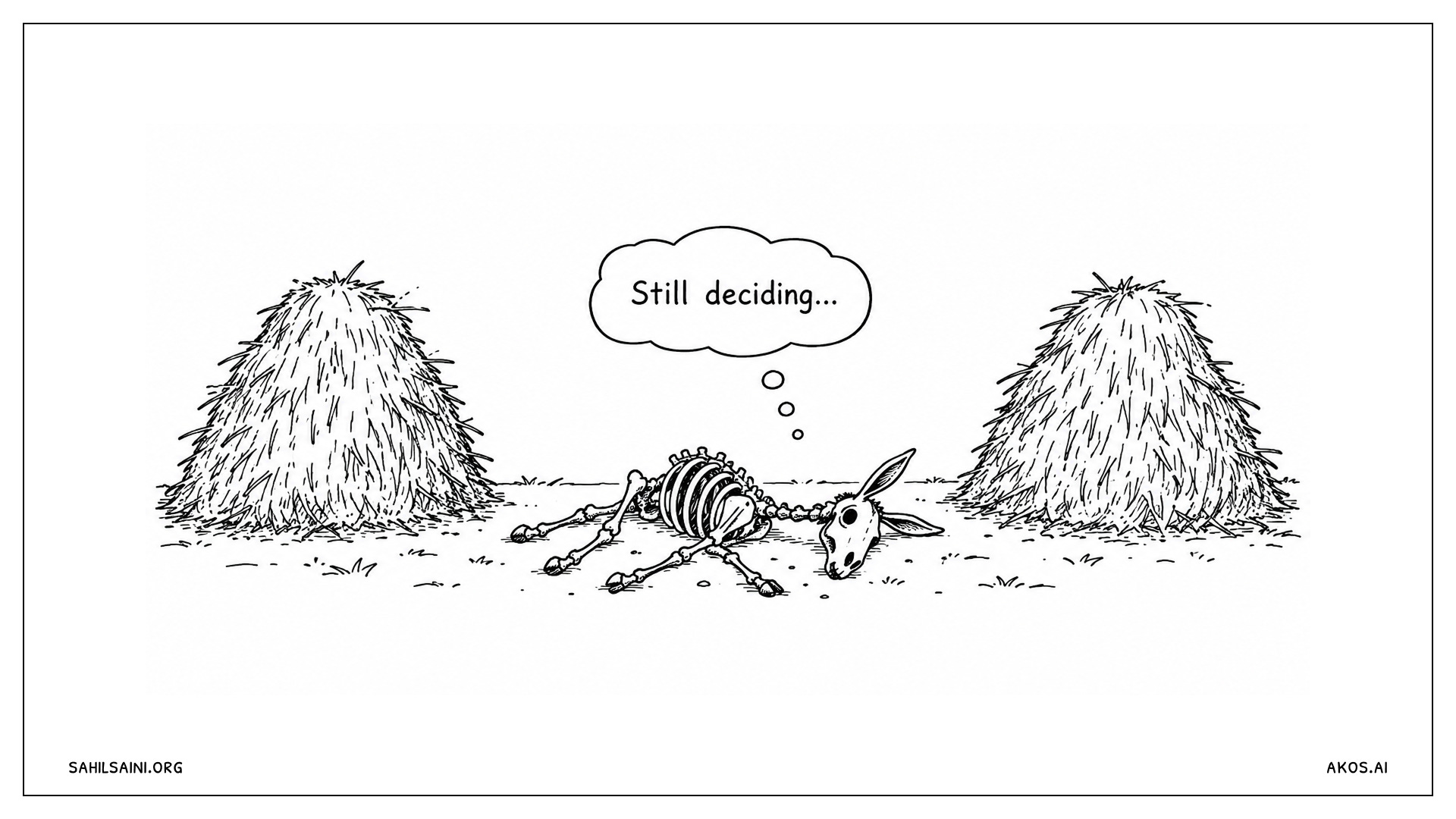
Reality doesn’t wait for epistemology.
Hire her or don’t.
Invest or don’t.
Build it or don’t.
Enter the market or don’t.
And importantly:
Not deciding is itself often a decision.
If you have $1M sitting in cash while deciding whether to invest it, you’ve chosen cash for another day.
So we have:
Incomplete information → Required action
That’s the fundamental problem.
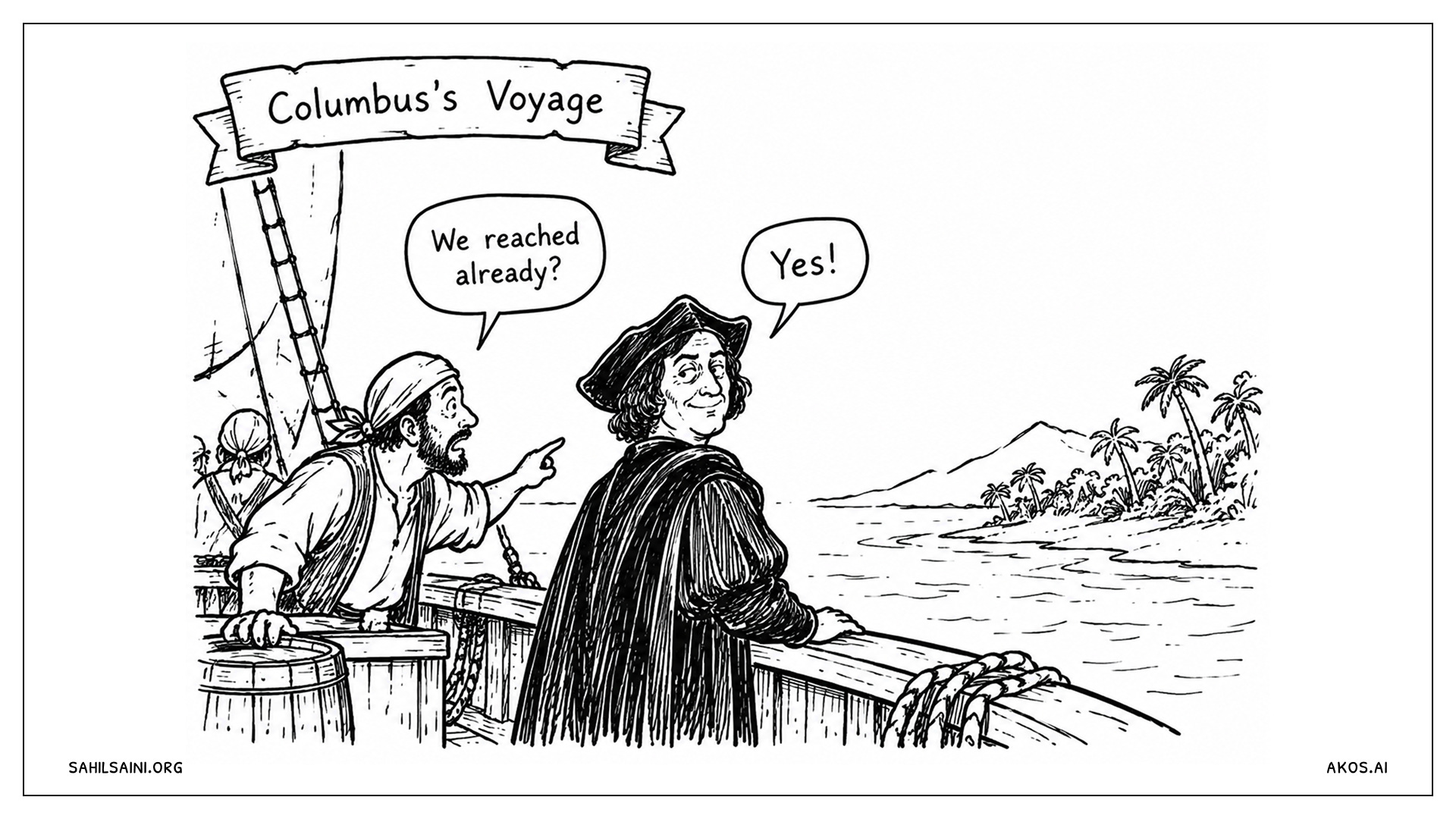
Axiom 4: Therefore, a good decision cannot require certainty
If information is inherently incomplete and decisions nevertheless must occur:
Decision quality cannot depend on outcome certainty
Instead, a rational objective has to look something more like:
Choose the best available action given the information available at the time.
This is why the poker example mattered.
We can make:
the right decision and get the wrong outcome.
And:
the wrong decision and get the right outcome.
Outcome alone cannot tell us whether reasoning was sound.
Axiom 5: More information is not automatically better
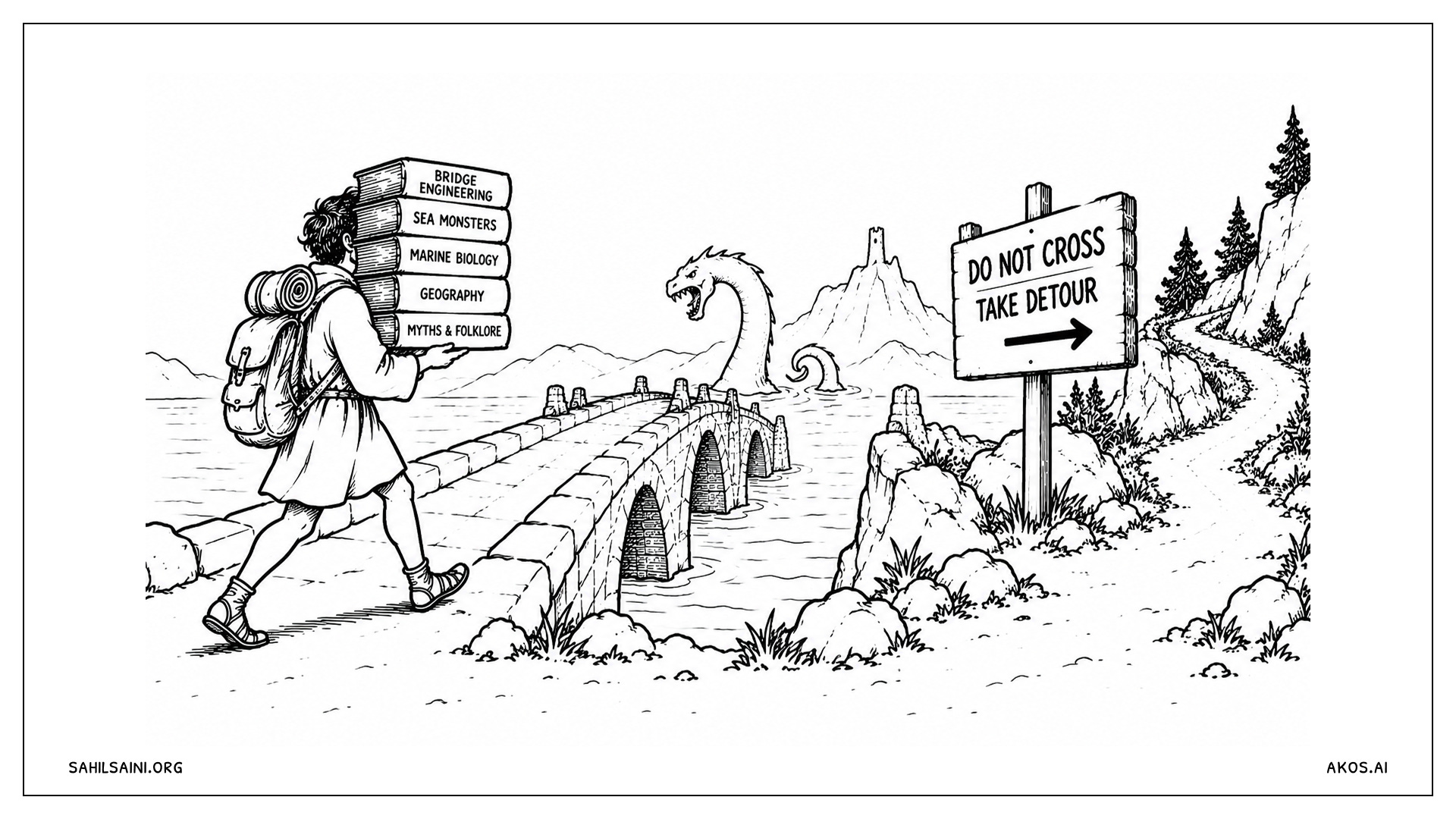
This one’s important because otherwise our principle becomes:
“Research everything.”
Suppose you’re buying a $100,000 piece of equipment.
There’s an unknown that has a 40% chance of changing your decision.
Worth investigating.
There’s another unknown with effectively no chance of changing your decision.
Researching it costs three weeks.
That information might be true and completely useless.
Therefore:
Value of information ≠ Amount of information
Its value comes from its ability to alter the action or materially improve its expected consequences.
So our rational thinker shouldn’t maximize knowledge.
They should maximize decision-relevant knowledge relative to its cost.
That’s a surprisingly important distinction.
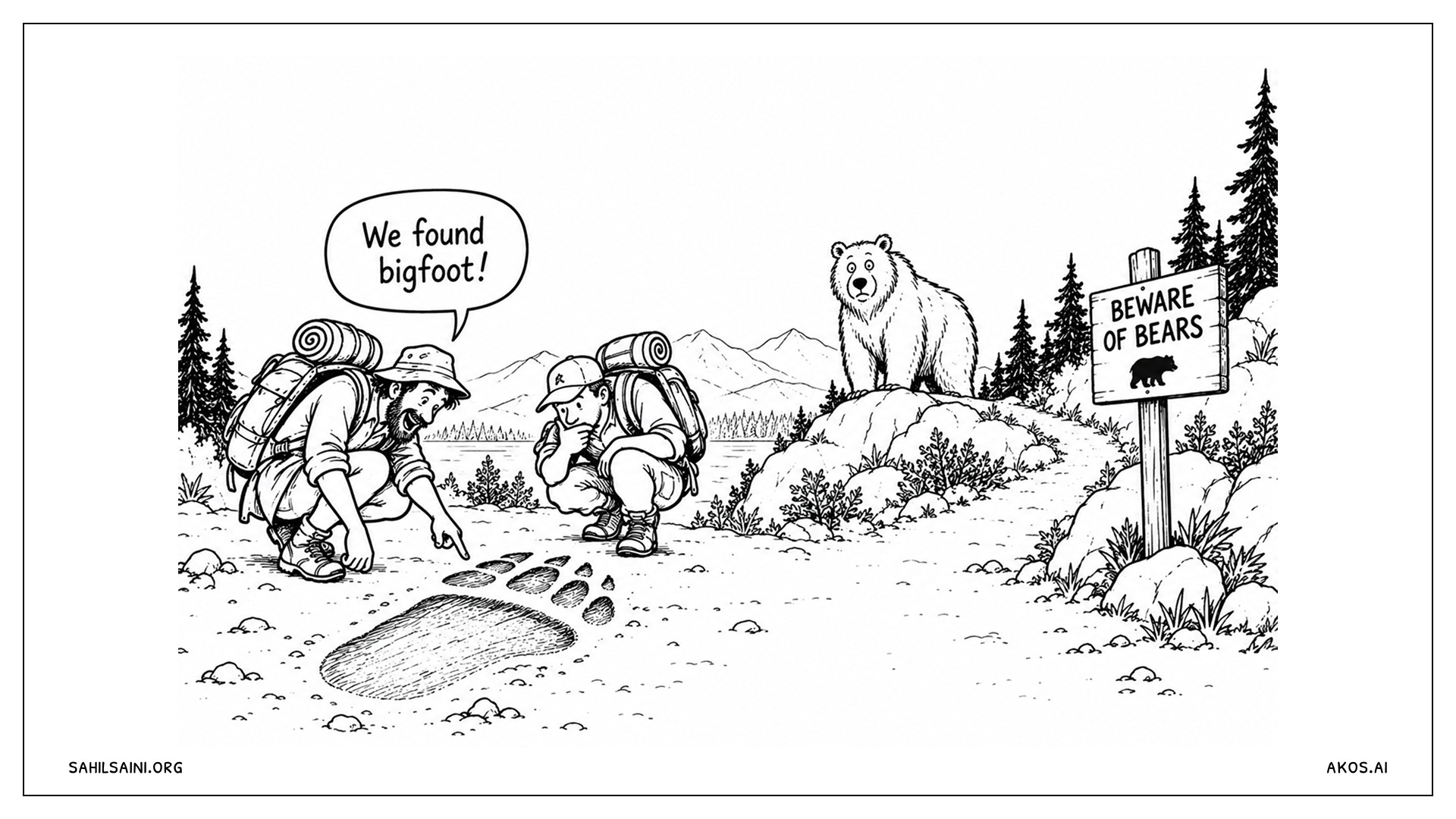
Axiom 6: Confidence should therefore be earned, not chosen
Now consider two people.
Person A:
“I’m 95% sure.”
Person B:
“I’m 65% sure.”
Which is the better thinker?
Impossible to tell.
Confidence itself isn’t a virtue.
If reality warrants 65%, then:
65% = good reasoning
and
95% = bad reasoning
Likewise, if evidence warrants 95%, saying 65% isn’t humility.
It’s miscalibration.
This is where I think our principle should explicitly reject the cult of uncertainty.
The objective isn’t lower confidence. It’s justified confidence.
That gives us:
Strength of belief ∝ Strength of evidence
Strength of belief should be proportional to strength of evidence.
Again, that’s our notation, not a scientific law.
And now something falls out of these axioms
Let’s combine our Axioms to a belief system:
1. Reality exists independently of me.
2. My model of reality is incomplete.
3. I cannot know everything.
4. I must act anyway.
5. Additional information has cost.
6. My confidence should reflect my evidence.
Therefore the rational objective cannot be:
Know everything before acting.
Nor:
Trust yourself and act confidently.
It has to be something between them:
Know what the evidence permits you to know,
preserve what it doesn’t,
reduce the unknowns that matter,
then act without pretending the remaining uncertainty disappeared.
That, to me, is the Honest Unknown Principle we’ve been circling. But I think we can sharpen it further.
I think there are actually two forms of intellectual dishonesty
We’ve talked mostly about:
False certainty
Evidence says uncertain → I say known
But there’s an inverse:
False uncertainty
Evidence supports conclusion → I say unknowable
This happens constantly.
Someone presents overwhelming evidence and another person retreats into:
“Well, nobody really knows.”
That’s not epistemic humility.
That’s an escape hatch.
So our principle should punish both errors.
Think of a scale:
Underclaim ← Evidence → Overclaim
The objective isn’t to move left.
It’s to stay in the middle, as close to the evidence.
That suggests a stronger formulation:
Never claim more certainty than the evidence earns, or less certainty than the evidence warrants.
I like that considerably more than:
“Be comfortable saying I don’t know.”
Meh! That’s obvious.
Because now the Honest Unknown isn’t a philosophy of doubt.
It’s a philosophy of fidelity.
Our belief should faithfully represent the information available.
And now I want to add one final axiom
This one isn’t necessary for the logic above.
But I think it’s necessary for our operating principle.
Axiom 7: Beliefs are temporary; the method is permanent
Today:
P(X) = 0.70 i.e. probability of X happening is 70%
Tomorrow you learn something important.
Now:
P(X) = 0.42, probably dropped down to 42% with new findings
Nothing has gone wrong.
In fact, something has gone right.
Your model moved toward reality.
So:
Changing your mind is not evidence that your previous reasoning failed. Refusing to change it when the evidence changes is.
That produces a very different relationship with conviction.
You can hold a thesis strongly without needing to defend it permanently.
I’d put it this way:
Be loyal to the process that produced the belief, not to the belief it produced.
That might be the most important sentence in this entire exercise.
Where we’ve arrived
We started six stages ago with a vague phrase:
The Honest Unknown.
Now we’ve derived something much richer:
1. Observe honestly
↓ ↓ ↓ ↓
2. Separate evidence from inference
↓ ↓ ↓ ↓
3. Expose decision-relevant unknowns
↓ ↓ ↓ ↓
4. Reduce the ones worth reducing
↓ ↓ ↓ ↓
5. Calibrate belief to evidence
↓ ↓ ↓ ↓
6. Act despite residual uncertainty
↓ ↓ ↓ ↓
7. Update when reality answers back
But I wouldn’t yet call that our principle.
It’s still too elaborate.
A first principle should compress.
Something you can invoke in ten seconds while someone is pitching you an investment, presenting a strategy, explaining why a product failed, or telling you something with suspicious certainty.
So I think there’s one final step worth doing.
Stage 7 should be synthesis.
We’ll take everything we’ve developed and compress it into perhaps 3 first principles, a handful of diagnostic questions, and one concise formulation of our Honest Unknown Principle.
Not borrowed philosophy. Not consultant-framework soup.
Something you can actually think with.
Stage 7: Our first-principles version
Now let’s compress.
If a principle needs a slide deck to invoke it, it has already lost.
I think everything we’ve covered reduces to three first principles.
I. Reality over narrative
Start with:
What do I actually know
Not: What do I think happened?
Not: What’s the most convincing explanation?
Not: What does my experience tell me?
Strip the claim down to observations first.
Fact: Revenue declined 18%.
Inference: Customers are leaving.
Explanation: Customers are leaving because the product is getting worse.
Prediction: Revenue will continue declining.
Four completely different epistemic objects.
Normal conversation casually welds them together:
“The product is getting worse, customers are leaving, and this business is declining.”
Sounds like one fact.
It might contain one fact and three layers of reasoning.
So:
Principle I
Never let the story inherit the certainty of the facts beneath it.
I think that’s worth remembering.
II. Unknowns are obligations, not weaknesses
Now we encounter something we don’t know.
Our instinct shouldn’t be embarrassment.
Nor should it be:
“Who knows?”
Instead:
Unknown? → What kind?
Can I look it up?
Can I measure it?
Can I test it?
Can I only estimate it?
Is it currently unknowable?
Or have I asked a bad question?
Then the crucial filter:
Would knowing it change what I do?
If yes, the unknown creates an obligation to investigate.
If no, perhaps it deserves to remain unknown.
This produces Principle II:
Principle II
Reduce the unknowns that can change the decision. Preserve the ones that cannot be honestly resolved.
That’s very different from “do more research.”
Sometimes the intellectually correct move is to stop researching.
III. Decisions are commitments to action, not claims of certainty
Eventually you arrive here:
“I still don’t know.”
Good.
Now what?
You act. Uncertainty does not mean inaction.
Uncertainty ⇏ inaction
You might say:
“Given what I know, I think acquiring this company is the best available decision. I’m about 70% confident. The biggest unresolved variable is customer concentration. If retention falls below X, my thesis changes.”
That’s enormously stronger than:
“This is a good acquisition.”
And stronger than:
“There’s too much uncertainty to know.”
You haven’t eliminated the unknown.
You’ve bounded it.
Then you’ve acted around it.
That leads to our third Principle:
Principle III
Act on the best available model without promoting the model into reality.
Now compress those three
We have:
1. Reality over narrative
What do I actually know?
2. Unknowns as obligations
What matters that I don’t know?
3. Action without certainty
Given both, what should I do?
Which gives us a remarkably compact sequence:
Known → Unknown → Action
But there’s one missing piece.
After action:
Reality → Update
So our actual loop becomes:
Know → Expose → Act → Update
That’s enough of a framework.
I wouldn’t make it any bigger.
Our Honest Unknown Principle
Now I’d formulate the principle itself this way:
Know only what the evidence earns. Preserve what remains unknown. Reduce the unknowns that matter. Then act.
I like every word there.
Know only what the evidence earns.
Prevents false certainty and false humility.
Preserve what remains unknown.
Don’t allow assumptions, narratives or confidence to silently fill the blanks.
Reduce the unknowns that matter.
Unknowns aren’t sacred. Attack the valuable ones.
Then act.
Uncertainty isn’t permission for paralysis.
That’s our principle.
But we need a check against it
Frameworks tend to become ceremonial. We don’t want to sit in a meeting thinking:
“Time to execute Stage IV of my Honest Unknown Methodology.” 🤓
So I’d reduce the audit to four questions.
When you have a strong opinion, especially one you’re excited about:
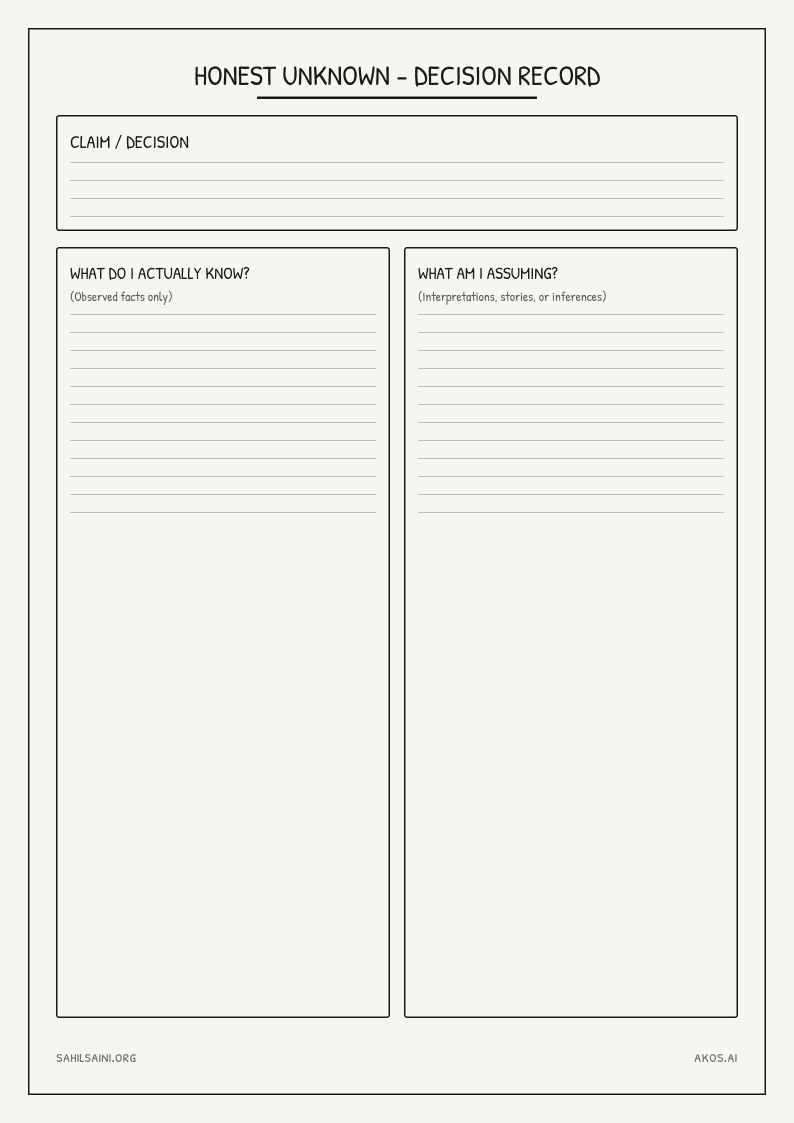
1. What do I actually know?
2. What am I assuming?
3. What don’t I know that could change my decision?
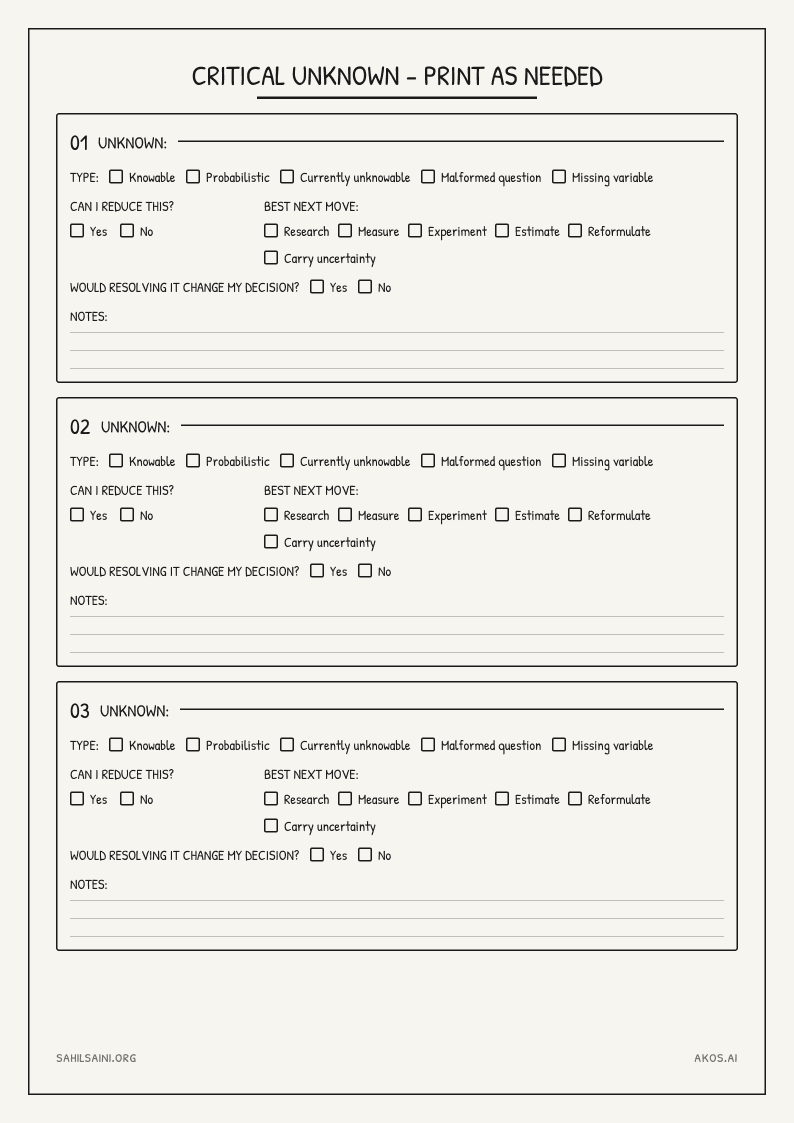
4. What would make me change my mind?
That’s it.
The first separates reality from narrative.
The second exposes inference.
The third finds the Honest Unknown.
The fourth prevents the thesis from becoming religion.
And if #3 reveals something knowable and important:
go find out.
If it reveals something unknowable:
carry the uncertainty.
If #4 has no answer:
you’re probably defending something rather than reasoning about it.
There’s an even faster version
In ordinary conversation you won’t run four questions.
So I’d train one reflex:
“What would have to be true?”
Someone says:
“AI agents will replace SaaS.” Ask: What would have to be true?
“This stock is undervalued.” Ask: What would have to be true?
“Customers don’t care about this feature.” Ask: What would have to be true?
“We should hire this person.” Ask: What would have to be true?
That question immediately begins exposing the hidden structure underneath a conclusion.
Then ask:
Which of those things do we actually know?
Now you’ve cracked the claim open.
And there’s one behavior I’d deliberately train
When you catch yourself saying: “I know...”
mentally substitute:
“What evidence would I need to deserve the word know?”
And when you catch yourself saying:
“We can’t know...”
ask:
“Can’t know, or haven’t found out?”
Those two questions protect opposite sides of the principle.
One attacks unjustified certainty.
The other attacks intellectual laziness disguised as humility.
The deepest version
After going through all seven stages, I actually think “Honest Unknown” undersells the philosophy we’ve built.
Because it sounds like the virtue is admitting ignorance.
That’s only one component.
The deeper principle is about maintaining an honest boundary between:
Reality
and
My representation of reality
Everything else follows from that.
Facts are pieces of the representation.
Inference extends it.
Unknowns mark its boundaries.
Probability describes uncertainty inside it.
Research expands it.
Decisions operate from it.
Feedback corrects it.
And ego corrupts it by confusing:
“My model says X”
with:
“X is true.”
So if I had to compress everything we’ve built into one sentence underneath the entire thing, it wouldn’t actually be about uncertainty.
It would be:
Be loyal to reality, not to your model of it.
Our model is disposable.
Reality gets the final vote.
That’s the endpoint of the formal lesson. From here, the interesting part would be pressure-testing this philosophy against real situations: an investment thesis, a product decision, a business strategy, a hiring decision, even one of your strongly held beliefs. That’s where we’ll find out whether the principle actually survives outside the laboratory.
Skill
You can install The Honest Unknown Principle as a Skill.md for your choice of LLM.
Cheatsheets
Download The Honest Unknown Principle Worksheet as PDF
References
Knowledge of Knowledge: Exploring Known-Unknowns Uncertainty with Large Language Models
Ancient Skepticism — Stanford Encyclopedia of Philosophy
Superforecasting: The Art and Science of Prediction — Philip E. Tetlock and Dan Gardner
Donald Rumsfeld’s “known knowns” remarks — CNN
RAND: Defense Supply Chain Resilience Research Agenda
NASA: Epistemic and Aleatory Uncertainties
How to Measure Anything — Douglas W. Hubbard
Thinking, Fast and Slow — Daniel Kahneman
Hindsight Is Not Equal to Foresight — Baruch Fischhoff
Rationality and Intelligence — Keith E. Stanovich
Conditions for Intuitive Expertise: A Failure to Disagree — Daniel Kahneman and Gary Klein
The Case for Motivated Reasoning — Ziva Kunda
A Simplified Method for Value of Information Using Constructed Scales
Karl Popper — Stanford Encyclopedia of Philosophy
Performing a Project Premortem — Gary Klein
Psychological Strategies for Winning a Geopolitical Forecasting Tournament — Mellers et al.